Guide
Body Types & Body Shapes: A Complete Guide
“Body type” can mean several different things.
In everyday fashion and styling, body type often means body shape—the relationship between areas such as the bust or chest, waist, hips, and shoulders. Labels such as Hourglass, Pear, Apple, Rectangle, Inverted Triangle, Triangle, and Spoon belong to this kind of proportion-based system.
But “body type” can also refer to male torso-shape categories, ectomorph, mesomorph, and endomorph somatotypes, Kibbe Image Identity terminology, or body-frame size.
These systems are not interchangeable.
This guide explains the main body-shape labels used on this site, how to identify your shape, how women’s and men’s body-type systems differ, and when another system may be more useful.
If you want an immediate measurement-based result, use the Body Shape Calculator. If you do not have measurements, take the Body Shape Test.
What Does “Body Type” Mean?
Body type is a broad everyday phrase rather than one single universal classification.
Depending on the context, someone asking “What is my body type?” may be looking for:
A body shape such as Hourglass, Pear, Apple, Rectangle, Inverted Triangle, Triangle, or Spoon.
A male torso-shape category such as Trapezoid, Rectangle, Oval, Triangle, or Inverted Triangle.
A somatotype label related to ectomorph, mesomorph, and endomorph.
A Kibbe style or Image Identity category.
A body-frame-size description such as small, medium, or large frame.
A body-composition measurement involving body fat, lean mass, or muscle.
Those are different questions.
On this site, “body shape” specifically refers to visible or measured proportions between different areas of the body. It is descriptive—not a health diagnosis, attractiveness ranking, or measure of body composition.
How Many Body Types Are There?
There is no single universally accepted number because different systems answer different questions.
A simple fashion guide may describe five common body shapes:
Hourglass
Pear
Apple
Rectangle
Inverted Triangle
Other systems add categories such as:
Triangle
Spoon
Top Hourglass
Bottom Hourglass
Round
Diamond
Balanced or mixed patterns
Our site uses different levels of detail depending on the tool.
The main Body Shape Calculator can return Hourglass, Top Hourglass, Bottom Hourglass, Pear, Triangle, Spoon, Inverted Triangle, Apple, Rectangle, or Balanced / Mixed.
The Body Shape Test intentionally uses six broader visual categories:
Hourglass
Pear
Apple
Rectangle
Inverted Triangle
Spoon
The important point is not the number of labels. A useful body-shape system should clearly explain what measurements or visual features it uses and should allow for people who sit between categories.
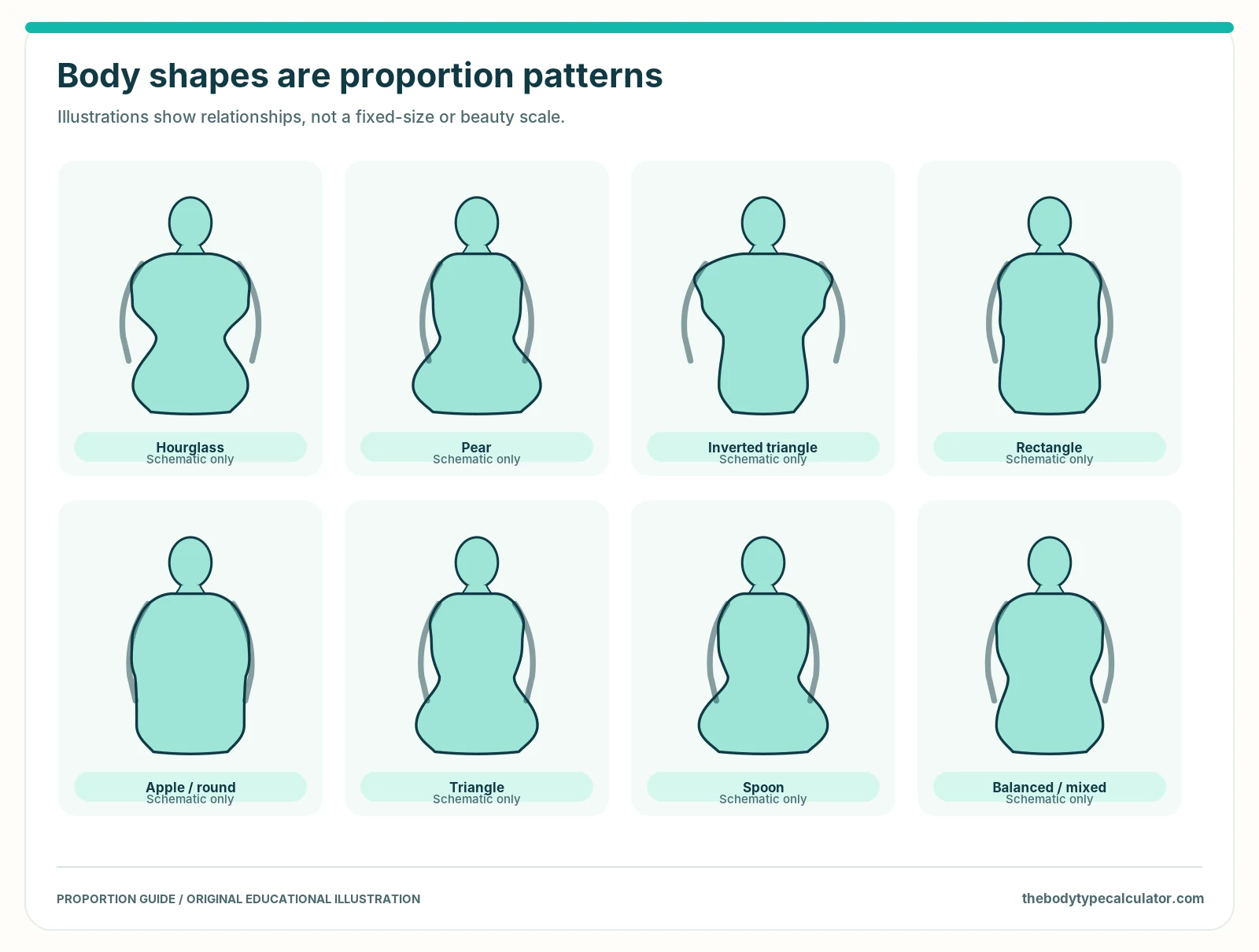
Body Shape Chart at a Glance
Hourglass
Upper and lower proportions are relatively balanced, with a noticeably smaller waist.
Pear
Hips/lower body are fuller or wider relative to the bust/chest or upper torso, usually with some waist definition.
Apple
The waist or midsection has less contrast relative to the bust/chest and hips.
Rectangle
Bust/chest, waist, and hips are comparatively similar, producing a straighter proportion pattern.
Inverted Triangle
The upper torso is wider or fuller relative to the hips.
Triangle
The hips are substantially larger relative to the upper torso. On our measurement calculator, Triangle and Pear are related but separated by different threshold conditions.
Spoon
The lower body is dominant and the upper hip has a more noticeable shelf or step before the fullest part of the hips.
Top Hourglass
A defined waist with the upper torso somewhat fuller than the hips.
Bottom Hourglass
A defined waist with the hips somewhat fuller than the upper torso.
Balanced / Mixed
The measurements do not strongly fit one single rule. A mixed result is a valid outcome rather than an error.
| Pattern | Typical relationship | Interpretation limit |
|---|---|---|
| Hourglass | Upper and lower body relatively balanced | Waist is more defined |
| Pear / triangle | Hips fuller than upper torso | Terminology may overlap |
| Inverted triangle | Upper torso fuller than hips | Shoulder width differs from circumference |
| Rectangle | Less waist-to-hip/chest contrast | Not a fitness description |
| Apple / round | Waist and torso closer to upper/lower circumference | Not body-fat estimation |
| Spoon | Lower-body dominance with upper-hip pattern | Separate high-hip reading may matter |
| Balanced / mixed | No single strong pattern | Valid result; labels are not rigid |
These are educational descriptions, not clinical classifications or standardized numeric thresholds.
The Main Body Shapes Explained
Hourglass Body Shape
An Hourglass shape has relatively balanced upper and lower measurements with a clearly smaller waist between them.
The key idea is balance plus waist definition—not a particular clothing size or body weight.
Our measurement calculator can also distinguish Top Hourglass and Bottom Hourglass variations when the upper and lower measurements are close but not perfectly balanced.
Pear Body Shape
A Pear shape is lower-body dominant. The hip measurement or visible lower-body width is greater than the upper torso, while the waist is usually more defined.
Pear is sometimes called a triangle shape in general fashion language, which is one reason different websites can appear to use different numbers of body types.
On this site, Pear and Triangle are kept as separate labels in the measurement calculator so the tool can describe different degrees and patterns of lower-body dominance.
Apple Body Shape
An Apple body shape has more visual or measured emphasis around the midsection, with less contrast between the waist and the surrounding torso measurements.
Apple does not mean a particular body weight. People at different sizes can have similar proportional patterns.
Rectangle Body Shape
A Rectangle shape has comparatively even upper-torso, waist, and hip proportions with less waist contrast than an Hourglass or Pear pattern.
“Rectangle” describes the relationship between measurements. It does not mean a body is literally straight or that someone has no curves.
Inverted Triangle Body Shape
An Inverted Triangle shape has more width or fullness through the upper body relative to the hips.
Depending on the system, that upper-body comparison may use shoulder width, shoulder circumference, or bust/chest measurements. Always check what a particular calculator is asking you to measure.
Triangle Body Shape
A Triangle shape is lower-body dominant, with the hips measuring or appearing wider than the upper body.
In general fashion writing, Triangle and Pear are often used as synonyms. Our Body Shape Calculator keeps them separate so it can return different labels for different measurement relationships.
Spoon Body Shape
A Spoon shape is related to lower-body-dominant patterns but includes a more noticeable upper-hip shelf.
This is why the Body Shape Calculator asks for optional high-hip circumference. Without high hip, the tool has less information for distinguishing Spoon from another lower-body-dominant shape.
Can You Be More Than One Body Shape?
Yes.
Body-shape labels turn continuous human proportions into a small set of categories. Someone can sit close to a boundary or share characteristics of two shapes.
That is why the visual Body Shape Test can return a Mixed result when top scores tie, and why the measurement calculator can return Balanced / Mixed when the measurements do not strongly meet a single rule.
If two labels both seem plausible, use them as descriptions rather than treating one as an identity you must prove.
How to Find Your Body Type
There are three useful ways to identify your body shape on this site.
1. Use measurements for the most repeatable result
The Body Shape Calculator uses bust/chest, waist, hip, and optional high-hip circumference.
Because the inputs are numerical, you can repeat the same process later and compare the result using the same rules.
2. Take a visual body shape test
If you do not have a measuring tape, the Body Shape Test asks five questions about upper-versus-lower balance, waist definition, where the body looks fullest, upper-hip shape, and overall silhouette.
It is faster but more subjective because it depends on how you judge your proportions.
3. Compare your proportions manually
You can also look at:
Whether the upper and lower body appear balanced.
How much smaller the waist appears than the bust/chest and hips.
Whether the hips or upper torso dominate.
Whether there is a distinct high-hip shelf.
Whether the overall line appears curved or relatively straight.
For a consistent measurement technique, see How to Take Body Measurements Correctly.
What Measurements Are Used to Determine Body Shape?
Different body-shape systems use slightly different inputs.
Our general Body Shape Calculator uses:
Bust or chest circumference.
Waist circumference.
Hip circumference.
Optional high-hip circumference.
Our Male Body Type Calculator instead uses:
Shoulder circumference.
Waist circumference.
Hip circumference.
That distinction matters. A calculator using shoulders is not necessarily applying the same classification rules as a calculator using bust/chest circumference.
Do not substitute straight-line shoulder width for circumference unless a tool specifically requests width.
Body Types for Women
Searches for “female body types,” “women body types,” and “body types for women” usually refer to proportion-based body shapes.
The most commonly discussed women’s body-shape labels include:
Hourglass
Pear
Apple
Rectangle
Inverted Triangle
Many guides also use:
Spoon
Triangle
Round
Top Hourglass
Bottom Hourglass
The labels are descriptive shortcuts. They are not exclusive to women, and they do not define femininity, health, fitness, clothing size, or attractiveness.
If your goal is simply to identify your proportion pattern, start with the Body Shape Calculator or Body Shape Test rather than trying to match yourself to a photograph.
Female Body Types Chart
For a simple comparison:
Hourglass — balanced upper/lower body + stronger waist definition.
Pear — lower body wider/fuller than upper body.
Apple — greater emphasis through the waist/midsection.
Rectangle — upper body, waist, and hips relatively similar.
Inverted Triangle — upper body wider/fuller than hips.
Spoon — lower-body dominance + upper-hip shelf.
Triangle — stronger lower-body dominance relative to the upper body.
Body Types for Men
Male body-type searches often use a different proportion system from general women’s body-shape guides.
Our Male Body Type Calculator uses shoulder, waist, and hip circumferences and returns five categories.
Trapezoid
Shoulders are broader than the waist and hips with a moderate taper.
Rectangle
Shoulder, waist, and hip relationships do not meet the stronger contrast rules for the other male categories.
Oval
The waist is relatively prominent compared with both hips and shoulders under the calculator’s rule set.
Triangle
Hips/lower body are wider relative to the shoulders.
Inverted Triangle
Shoulders are substantially broader relative to the waist and hips.
For the exact rules and calculator, see Male Body Type Calculator.
Male and female body-type systems should not be treated as direct translations of one another. They can use different measurements, different labels, and different thresholds.
Body Shape vs Somatotype
Ectomorph, mesomorph, and endomorph belong to a different body-build framework called somatotyping.
They are not synonyms for Hourglass, Pear, Apple, Rectangle, or Inverted Triangle.
In formal Heath-Carter somatotyping, a physique is described using three numerical components:
Endomorphy — relative fatness.
Mesomorphy — musculoskeletal robustness relative to height.
Ectomorphy — relative linearity.
That is more nuanced than the popular idea that every person belongs entirely to one of three boxes.
Our Simplified Somatotype Estimator is intentionally not the formal Heath-Carter method and does not claim to predict metabolism, athletic ability, or how someone will respond to training.
Read the individual guides:
Body Shape vs Kibbe Body Types
Kibbe terminology belongs to a style and Image Identity system rather than a simple bust-waist-hip body-shape chart.
David Kibbe’s system looks at an overall visual impression and style identity, not just whether the hips are wider than the bust or whether the waist is defined.
That is why an Hourglass body-shape result does not automatically translate into one specific Kibbe Image Identity.
For the broader educational overview, see Kibbe Body Types.
For our independent simplified quiz, see Kibbe Body Type Test.
Our Kibbe quiz is unofficial and returns only five broad style-family labels. It is not David Kibbe’s official assessment.
Body Shape vs Body Frame Size
Body frame size is another separate concept.
Frame-size references usually compare measurements such as height and wrist circumference to describe a smaller, medium, or larger skeletal frame.
A person with any body shape can have a smaller, medium, or larger frame.
Body Shape vs Body Composition
Body composition refers to components of body mass, such as fat mass and fat-free or lean mass.
A body-shape label does not measure body-fat percentage or muscle mass.
Two people can have a similar silhouette or the same body-shape label while having very different:
Heights.
Weights.
Muscle mass.
Body-fat levels.
Bone structure.
Posture.
Clothing sizes.
This is why body shape should not be used as a substitute for medical or body-composition assessment.
Body Type vs Clothing Size
Body type and clothing size are not the same thing.
Clothing size is a garment-sizing convention, and sizing differs across brands and countries.
Body shape compares proportions within the same body.
Two people can wear the same nominal size but have different waist-to-hip or upper-to-lower-body relationships. They may therefore experience very different fit in the same garment.
When choosing a specific item of clothing, your actual measurements and the brand’s size chart matter more than a body-type label.
For styling guidance, see How to Dress for Your Body Type.
Can Body Type Change?
Some body-type labels can change if the measurements used by that system change.
For example, the Body Shape Calculator compares circumferences. If the relationship between bust/chest, waist, high hip, and hips changes enough to cross a classification boundary, the calculator can return a different shape.
Likewise, the male calculator can return a different category if shoulder, waist, and hip proportions change.
That does not mean a person has become a fundamentally different kind of person. It only means the measurements now match a different simplified category.
Does Weight Determine Your Body Shape?
No—not by itself.
Our Body Shape Calculator does not use body weight at all.
Body shape depends on the relationship among the measurements used by the classification system. Weight changes can sometimes change those measurements, but two people at the same weight can have very different proportions.
Likewise, two people with the same shape label can have very different weights and heights.
Are Body Types Scientific?
It depends on which “body type” system you mean.
Common geometric body-shape labels such as Hourglass, Pear, Apple, and Rectangle are broad descriptive or styling categories. They are not standardized medical diagnoses, and the exact labels and boundaries vary between guides and calculators.
Formal anthropometric systems such as Heath-Carter somatotyping have defined measurement methods and numerical components, but that is different from the simplified internet use of “ectomorph,” “mesomorph,” and “endomorph.”
Kibbe is a style/Image Identity system, not a medical classification.
The safest approach is to ask what a system measures, what its rules are, and what the result is actually intended to tell you.
Which Body Type Is Best?
There is no objectively best body type.
Body-shape labels describe proportions. They are not rankings of attractiveness, health, fitness, femininity, masculinity, or personal value.
A category is useful only if it helps answer a practical question—for example, understanding garment fit, comparing proportions, or finding the right tool for a style system you are exploring.
What Is the Most Common Body Type?
There is no single universal answer that should be applied to everyone.
Published fashion guides sometimes quote percentages from specific body-scan studies or datasets, but prevalence depends on:
Which classification rules were used.
The population studied.
Age range.
Sex/gender composition.
Geography.
Measurement technique.
How borderline cases were assigned.
Because different systems use different definitions, this site does not present one body type as universally “the most common.”
How Body Type Can Help With Clothing Fit
A proportion label can help explain recurring fit patterns.
For example:
A larger upper-to-lower contrast can affect how jackets fit across the shoulders versus hips.
A larger hip-to-waist contrast can affect trouser and skirt fit.
Lower waist contrast can affect where garments create or follow shape.
A high-hip shelf can change how fitted skirts or trousers sit before reaching the fullest hip.
Use body type as a fit clue, not a clothing rule.
You do not need to “correct” or hide your shape, and there is no requirement to dress toward an Hourglass silhouette.
For detailed outfit guidance, see How to Dress for Your Body Type.
Body Type and Health Are Different Questions
A body-shape label is not a health assessment.
Hourglass, Pear, Apple, Rectangle, Triangle, Spoon, and Inverted Triangle are proportion descriptions on this site.
If your goal is a health-related anthropometric screening measure, use the Waist-to-Hip Ratio Calculator instead and read its limitations carefully: Waist-to-Hip Ratio Calculator
WHR is also not a diagnosis. Health interpretation belongs in a broader clinical context.
Which Body Type Tool Should You Use?
Use the Body Shape Calculator if:
You have circumference measurements.
You want a repeatable proportion-based body-shape result.
You are looking for Hourglass, Pear, Apple, Rectangle, Spoon, Triangle, or Inverted Triangle-type labels.
Use the Body Shape Test if:
You do not have measurements.
You want a quick visual self-assessment.
You are comfortable with a more subjective result.
Use the Male Body Type Calculator if:
You specifically want male torso-shape labels.
You have shoulder, waist, and hip circumferences.
You want Trapezoid, Rectangle, Oval, Triangle, or Inverted Triangle classification.
Use the Simplified Somatotype Estimator if:
You are specifically exploring ectomorph, mesomorph, and endomorph terminology.
You understand that the tool is simplified and not the formal Heath-Carter method.
Use the Kibbe Body Type Test if:
You are exploring broad Kibbe-inspired style-family language.
You understand that the quiz is unofficial and does not assign an official Image Identity.
Use the Body Visualizer if:
You want to see a simple 2D silhouette generated from your measurements.
You want a visual representation rather than a category label.
Frequently Asked Questions
What are body types?
“Body types” can refer to several classification systems. In everyday styling, the phrase often means body shapes such as Hourglass, Pear, Apple, Rectangle, Inverted Triangle, Triangle, and Spoon. It can also refer to somatotypes, male torso shapes, Kibbe style identities, or frame size.
What are the main body shapes?
Five labels appear very commonly in style guides: Hourglass, Pear, Apple, Rectangle, and Inverted Triangle. Other systems add Spoon, Triangle, Round, or Hourglass variations. There is no single universal taxonomy.
What body type am I?
If you mean body shape, use the Body Shape Calculator with bust/chest, waist, hip, and optional high-hip measurements. If you do not have measurements, use the Body Shape Test.
What are the female body types?
Common women’s body-shape labels include Hourglass, Pear, Apple, Rectangle, Inverted Triangle, Spoon, and Triangle. Different guides may combine or rename some categories.
What are the male body types?
Our male calculator uses Trapezoid, Rectangle, Oval, Triangle, and Inverted Triangle based on shoulder, waist, and hip circumferences.
How many body types are there?
There is no single answer because body-shape, somatotype, Kibbe, male-shape, and frame-size systems use different categories. Even within fashion body-shape systems, some use five categories while others use more.
Can I have two body types?
Yes. Real proportions can sit between simplified categories. Our Body Shape Test can return a mixed tie, and the Body Shape Calculator can return Balanced / Mixed when one rule is not clearly dominant.
Is body shape the same as body type?
Sometimes people use the terms interchangeably, but “body type” is broader. It can also refer to somatotype, Kibbe, frame size, or other systems.
Is body shape the same as body composition?
No. Body shape describes proportions. Body composition refers to components such as fat mass and fat-free mass.
Are ectomorph, mesomorph, and endomorph body shapes?
They are somatotype terms, not the same system as Hourglass, Pear, Apple, or Rectangle.
Is Kibbe the same as body shape?
No. Kibbe is a style/Image Identity system and does not reduce directly to bust-waist-hip body-shape categories.
Does weight determine body type?
Not in our body-shape calculator. It does not use weight. Proportions between body measurements determine the result.
Can my body type change?
A measurement-based body-shape result can change if the proportions used by the calculator change enough to cross a classification boundary.
What is the best body type?
There is no objectively best body type. These labels are descriptive rather than rankings.
What is the most common female body type?
There is no universal answer that applies to every population because classification rules and study populations differ.
How do I measure my body type?
For the general calculator, measure bust/chest, waist, hips, and optionally high hip. Use a flexible tape and keep each circumference level around the body.
Explore All Body Type Guides and Tools
Find your shape:
Body-shape guides:
Other body-type systems:
Measurements and proportions:
Style: