Guide
Bust, Waist & Hip Measurements: How to Measure Correctly
Bust, waist and hip measurements are three circumference measurements used in clothing fit, sewing, tailoring and body-proportion tools. They are usually written in that order — bust, waist, hips — such as 36-28-40 inches.
The numbers are useful only when they are taken at consistent landmarks. Measure the fullest part of the bust or chest, the natural waist, and the fullest part of the hips and seat. Use a soft tape, keep it level around the body, and make it snug without pulling it tight.
If you are measuring for a calculator on this site, use the same unit for every field. If you are measuring for clothing, also check the brand’s own size chart because size labels are not standardized across brands.
What Do Bust-Waist-Hip Measurements Mean?
Bust-waist-hip measurements describe the circumference of three different parts of the torso and lower body. The first number is the bust or chest circumference, the second is the natural waist circumference, and the third is the full hip circumference.
For example, 36-28-40 means a 36-inch bust, 28-inch waist and 40-inch hips. The same measurements could also be written in centimeters, but the unit should always be stated so the numbers are not misread.
These measurements do not tell you a person’s height, weight, body fat percentage, clothing size or health status. They describe circumference at three locations. Their relationship to one another can also be used in body-shape and proportion calculations.
What You Need Before You Measure
A flexible sewing tape is the easiest tool to use because it follows the body’s curves. A mirror helps you check whether the tape stays horizontal across your back, and a second person can help if you find it difficult to keep the tape level.
- Use a soft, flexible measuring tape.
- Measure over underwear or thin, close-fitting clothing rather than bulky layers.
- Stand naturally with your shoulders relaxed and breathe normally.
- Keep the tape flat against the body without twisting it.
- Pull the tape comfortably snug, not tight enough to compress the body.
- Record each number immediately and repeat any measurement that seems unusual.
How to Measure Bust, Waist and Hips
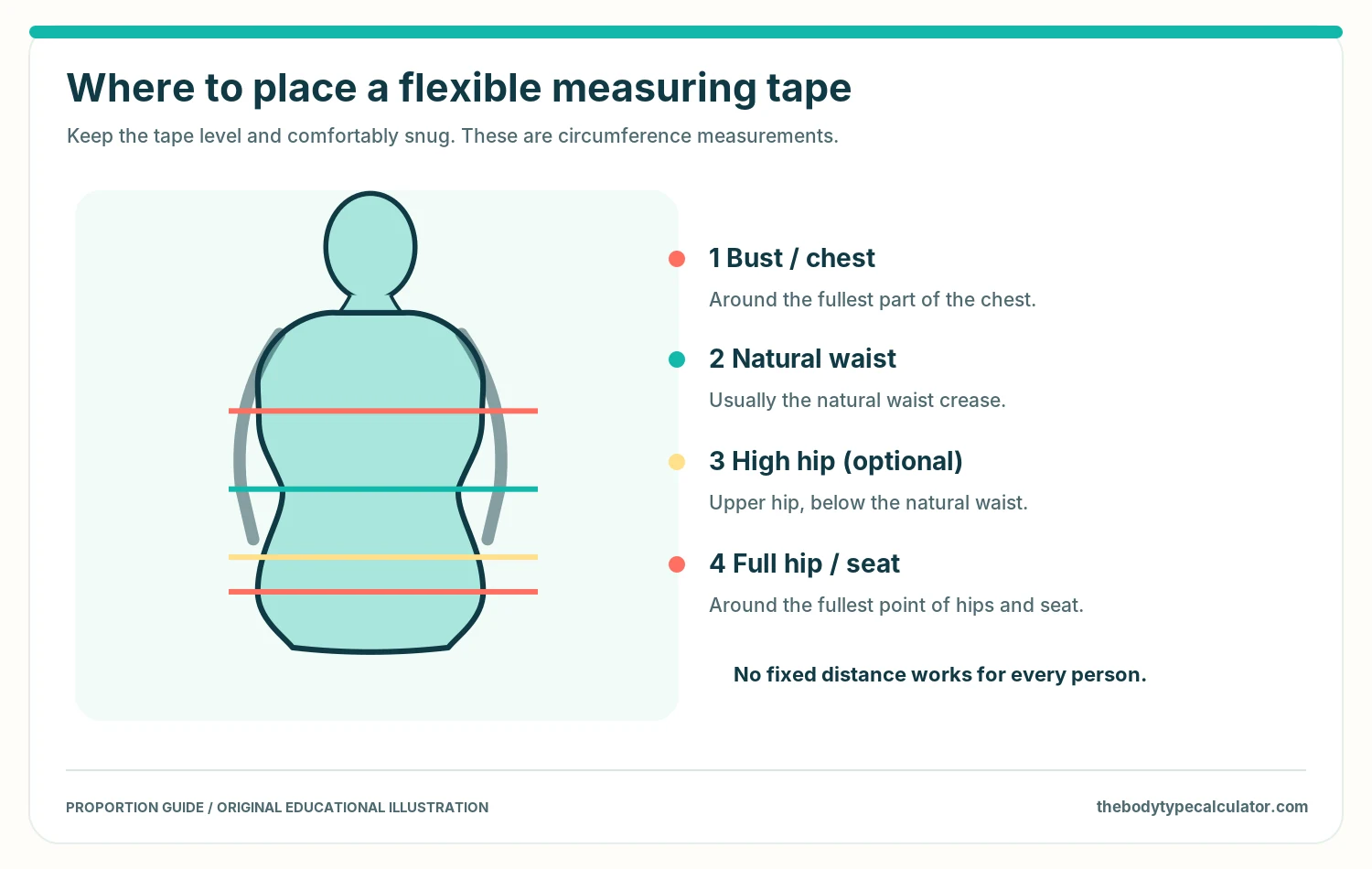
Use the visual below as a placement reference. The exact shape of every body is different, so use anatomical landmarks rather than trying to place the tape at a fixed distance from the floor.
1. Measure the bust or chest
Wrap the tape around the fullest part of your bust or chest. Keep your arms relaxed at your sides and check that the tape is at the same height across your back as it is at the front.
For clothing measurements, wear the type of bra or undergarment you expect to wear with the garment, especially if it changes your bust profile. Avoid heavily padded layers unless the garment will actually be worn over them.
2. Find and measure your natural waist
Your natural waist is usually the narrowest part of your torso between the rib cage and hips. If the location is not obvious, bend gently to one side; the crease that forms often helps you locate the natural waist.
Wrap the tape around that point, stand normally and measure without sucking in your stomach. A clothing or body-shape waist measurement is not necessarily the same location as the waistband of your jeans or trousers.
3. Measure the full hips
Stand with your feet in a natural, stable position and wrap the tape around the fullest part of your hips and seat. Check the side and back in a mirror if possible, because a tape that slopes upward or downward can change the number.
The hip measurement used for body-shape calculators and most clothing charts usually means the full hip, not the high hip.
4. Measure the high hip only when a tool or pattern asks for it
High hip is a separate circumference around the upper hip area below the natural waist and above the fullest part of the hips. Its exact position varies between people and between sewing systems, so follow the instructions for the specific calculator, pattern or garment.
On this site, the main Body Shape Calculator treats high hip as optional. It can provide extra information for distinguishing a spoon-shaped pattern from other lower-body-dominant shapes.
Bust vs Underbust: They Are Not the Same Measurement
Bust circumference goes around the fullest part of the bust. Underbust circumference goes around the rib cage directly beneath the bust and is commonly used in bra-fitting methods. Do not substitute an underbust measurement when a body-shape calculator, dress pattern or size chart asks for bust.
Natural Waist vs Trouser Waist
The natural waist is an anatomical measurement point. A garment waist is where a specific pair of trousers, skirt or waistband is designed to sit. High-rise, mid-rise and low-rise garments can all sit at different levels, so the garment waist may not match your natural-waist circumference.
When you are using a body-measurement guide or body-shape calculator, use the natural waist unless the instructions explicitly say otherwise. When you are buying clothing, compare your body measurements with the brand’s instructions and garment-specific size chart.
High Hip vs Full Hip
High hip and full hip describe two different circumferences. High hip is taken around the upper pelvic area below the waist. Full hip is taken around the widest part of the hips and seat.
The difference matters for fitted skirts, trousers, pattern alterations and some body-proportion tools. If a field simply says “hips” on this site, it refers to full hips unless the page specifically labels the field as high hip.
How Tight Should the Measuring Tape Be?
The tape should touch the body all the way around without digging in or leaving a gap. If the tape indents soft tissue, the measurement is probably too tight. If it can slide far away from the body, it is too loose.
Consistency matters more than trying to force an artificially small number. Measure naturally, then repeat the measurement once. If the readings differ, reset the tape and try again rather than averaging obviously inconsistent placements.
Common Measurement Mistakes
- Measuring the waistband of your clothes instead of your natural waist.
- Using high hip when a calculator asks for full hip.
- Letting the tape slope down across the back.
- Pulling the tape tight enough to compress the body.
- Measuring over thick sweaters, jackets or bulky pockets.
- Holding your breath or pulling in your stomach.
- Mixing inches and centimeters in the same calculation.
- Assuming a familiar clothing size can replace actual body measurements.
How to Read Measurements Written as 36-28-40
A three-number set such as 36-28-40 normally follows the order bust-waist-hips. In this example, the bust is 36 inches, the waist is 28 inches and the hips are 40 inches.
The notation alone does not identify a body shape. Body-shape systems compare the differences and ratios between measurements, and different systems use different thresholds. If you want a repeatable estimate, enter the measurements into the Body Shape Calculator rather than guessing from a three-number set.
How to Convert Inches and Centimeters
One inch equals exactly 2.54 centimeters. To convert inches to centimeters, multiply by 2.54. To convert centimeters to inches, divide by 2.54.
For example, 36 inches is 91.44 cm. For ordinary clothing or body-measurement use, rounding to the nearest 0.5 cm or 0.25 inch is usually more practical than recording many decimal places, unless a specific tool tells you otherwise.
What Can You Use Bust-Waist-Hip Measurements For?
Body-shape calculations
A body-shape calculator compares circumference relationships rather than judging one measurement by itself. Bust, waist and hips can help identify simplified patterns such as hourglass, pear, apple or rectangle. These labels are descriptive categories, not grades or ideals.
Clothing size charts
Many women’s size charts use bust, waist and hip ranges. Compare all three measurements rather than choosing a size from only one number. If different parts of your body fall into different sizes, the best choice depends on the garment’s cut, fabric stretch and the area that is hardest to alter.
Sewing and tailoring
Accurate body measurements help with selecting a pattern size, making alterations and checking where extra ease is needed. Sewing patterns may ask for additional measurements such as high bust, back waist length, shoulder width or inseam.
Tracking changes over time
If you track measurements, use the same landmarks and similar measuring conditions each time. A change in tape placement can look like a body change even when your proportions have not meaningfully changed.
Body Measurements vs Clothing Measurements
A body measurement follows your body. A garment measurement describes the finished clothing item. Garments normally include ease — extra room for movement, comfort or a deliberately relaxed silhouette — so a finished garment may measure larger than the body it is designed to fit.
This is why a shirt with a 40-inch finished bust measurement does not automatically correspond to a 40-inch body bust. Always check whether a retailer is publishing body measurements or garment measurements.
A Note About Waist Measurements Used for Health Screening
“Waist circumference” can refer to different landmarks depending on the purpose. Clothing and body-shape guides often use the natural waist. Clinical and public-health protocols may use a standardized landmark such as the area just above the hip bones or a defined point between the ribs and pelvis.
Do not use a fashion measurement guide as a medical measurement protocol. If you are measuring waist circumference for health screening, follow the instructions from your clinician or the specific health authority you are using.
Are There Ideal Bust-Waist-Hip Measurements?
No single set of bust, waist and hip measurements is an objective “ideal.” Measurements vary with height, skeletal structure, genetics, age and many other factors. Clothing fit and body-shape labels are practical uses of the numbers; they should not be treated as a ranking of bodies.
If you encounter measurements such as 36-24-36 described as an “ideal,” treat that as a cultural or historical beauty convention rather than a universal standard. Our separate 36-24-36 guide explains the notation and context without presenting it as a target.
Frequently Asked Questions
What order do bust, waist and hip measurements go in?
The usual order is bust-waist-hips. A measurement written as 34-27-38 generally means a 34-inch bust, 27-inch waist and 38-inch hips, unless another unit is stated.
Where exactly do I measure my waist?
For clothing and body-shape measurements, use your natural waist, usually the narrowest part of your torso. A gentle side bend can help you find the crease. Health-screening protocols may use a different landmark.
Where do I measure my hips?
Measure around the fullest part of your hips and seat, keeping the tape level all the way around. Do not use high hip unless the instructions specifically ask for it.
Should I measure over clothes?
For body measurements, use underwear or thin, close-fitting clothing when practical. Thick fabric and bulky pockets can add circumference and make readings less consistent.
Should the tape be tight?
No. It should be snug enough to stay in contact with the body but not tight enough to compress it.
Can I measure myself without help?
Yes. A mirror can help you check the tape across the back. For measurements that are difficult to keep level, asking another person to help can improve consistency.
Are bust-waist-hip measurements the same as clothing size?
No. They are body measurements. Clothing sizes are labels assigned by brands, and the same measurements can map to different sizes across different brands and garment types.
Can I use centimeters instead of inches?
Yes. Keep all measurements in the same unit. The calculators on this site that offer an inch/cm selector handle the unit conversion for you.