Guide
Triangle Body Shape: Measurements, Characteristics & Style Guide
A Triangle body shape describes a lower-body-dominant proportion pattern where the hips are noticeably larger than the bust/chest or upper torso.
This is the opposite direction from an Inverted Triangle, where the bust/chest measurement is larger than the hips. Compare the measurement relationships rather than the names alone.
Many fashion guides use Triangle and Pear as two names for the same shape. This site uses a more specific calculator taxonomy: Triangle is reserved for stronger hip-over-bust dominance, while Pear is used for a more moderate lower-body difference with a defined waist.
The label is about proportions—not body weight, clothing size, fitness, or attractiveness. A Triangle body can be slim, curvy, athletic, petite, tall, midsize, plus-size, soft, or muscular.
If you want to check your own measurements, use the Body Shape Calculator.
What Is a Triangle Body Shape?
A Triangle body shape widens from the upper torso toward the hips and lower body.
Common visual characteristics can include:
Hips wider than the bust/chest or shoulders.
More visual width through the hips, seat, or thighs.
A narrower-looking upper torso.
A waist that may be clearly defined, moderately defined, or relatively straight.
A lower-body-dominant overall silhouette.
In general fashion language, this is very often called a Pear shape.
On this site, however, Triangle and Pear are separate measurement-based results.
That distinction is site-specific.
Triangle Body Shape Characteristics
A Triangle-shaped body may have:
Hip circumference clearly larger than bust/chest circumference.
More lower-body visual weight than upper-body visual weight.
A smaller or narrower upper torso relative to the hips.
A waist that can vary from defined to moderate.
Clothing-size differences between upper and lower body.
Trousers that fit the hips but feel loose at the waist.
A Triangle body can also have:
A small or fuller bust.
Broad or narrow shoulders.
Hip dips.
A short or long torso.
Slim or muscular legs.
A petite, tall, slim, midsize, or plus-size frame.
The category describes the overall relationship among measurements, not every individual feature.
Triangle Body Shape Measurements
There is no universal Triangle formula used by every fashion guide.
Our v2 Body Shape Calculator uses this Triangle rule:
Hip circumference is at least 5 inches larger than bust/chest circumference.
In formula form:
hips − bust/chest ≥ 5 inches
Equivalent centimeter measurements are converted internally before the rule is applied.
However, the calculator checks several other categories first, so a 5-inch hip advantage does not automatically guarantee a Triangle result.
Triangle Rule Order Matters
Before Triangle, plugin v2 checks:
Hourglass
Top Hourglass
Bottom Hourglass
Spoon
If one of those earlier rules matches, that result takes precedence.
After Triangle, the calculator checks:
Pear
Inverted Triangle
Apple
Rectangle
If no rule matches, the result remains Balanced / Mixed.
This means the most accurate site-specific definition is:
Triangle = hips at least 5 inches larger than bust/chest, provided an earlier Hourglass-family or Spoon rule has not already matched.
Triangle Body Shape Example
Example:
Bust/chest: 35 in
Waist: 31 in
Hips: 40 in
Hip–bust difference:
40 − 35 = 5 inches
The Bottom Hourglass rule does not trigger because the waist-to-hip ratio is:
31 ÷ 40 = 0.775
Bottom Hourglass requires waist-to-hip below 0.75.
If no Spoon condition is triggered, the calculator reaches the Triangle rule and returns Triangle.
Why Strong Waist Definition Can Change the Result
Consider:
Bust/chest: 35 in
Waist: 28 in
Hips: 40 in
The hips are still 5 inches larger than the bust/chest.
But:
Waist is at least 9 inches smaller than hips.
Waist-to-hip ratio is 0.70.
Those values satisfy the earlier Bottom Hourglass rule.
The calculator therefore returns Bottom Hourglass before it reaches Triangle.
This is why one hip–bust difference should not be interpreted in isolation.
How to Measure for a Triangle Body Shape
Use a flexible, non-stretch measuring tape and stand naturally.
Bust or chest
Measure around the fullest part of the bust/chest. Keep the tape level and snug without compressing the body.
Waist
Measure around the natural waist, usually the narrowest part of the torso. Do not pull your stomach in.
Hips
Measure around the fullest part of the hips and seat, keeping the tape horizontal.
High hip
High hip is optional in the general calculator. It is especially useful when distinguishing Spoon from other lower-body-dominant shapes.
For a full measurement walkthrough, see How to Take Body Measurements Correctly.
How Do I Know If I Have a Triangle Body Shape?
The most repeatable method is to use measurements.
1. Measure bust/chest.
2. Measure natural waist.
3. Measure hips.
4. Optionally measure high hip.
5. Enter the values into the Body Shape Calculator.
6. Compare Triangle with Pear, Spoon and Bottom Hourglass if your proportions are near a boundary.
If you do not have measurements, the Body Shape Test can give you a broader visual lower-body-dominant result. Note that the visual quiz does not output Triangle separately; it groups this kind of visual pattern primarily under Pear/Spoon-style results.
What Does a Triangle Body Shape Look Like?
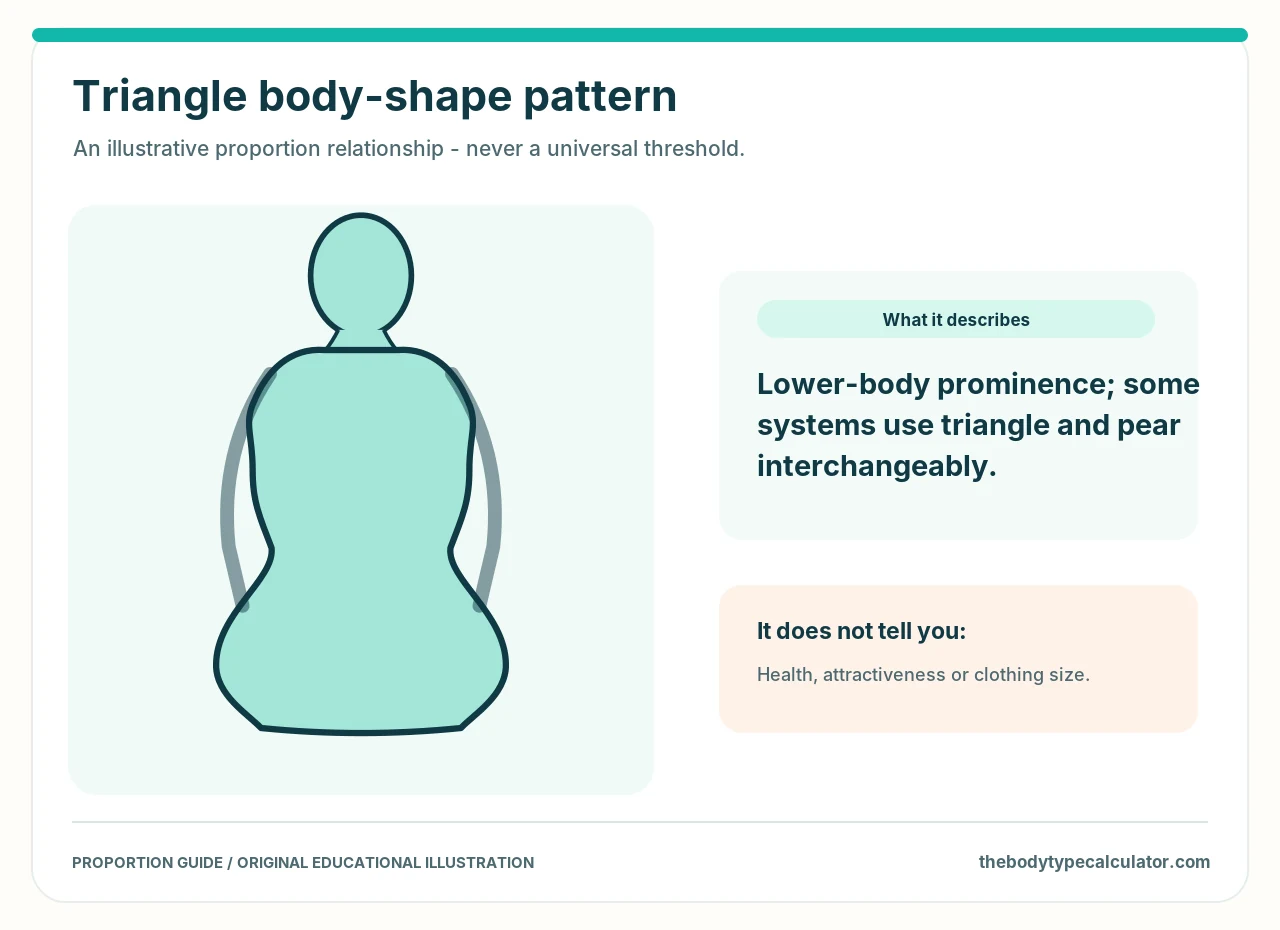
Visually, a Triangle shape usually narrows through the upper torso and becomes wider through the hips/lower body.
The silhouette may look:
Narrower above the waist.
Wider through the hips or upper thighs.
Defined or moderately defined at the waist.
Strongly lower-body dominant.
The same category can look very different across heights, body sizes, torso lengths, muscle levels, shoulder structures, and body-fat distribution.
An illustration is only a simplified teaching aid.
Triangle Body Shape Illustration
Triangle vs Pear Body Shape
This is the most important terminology issue on the page.
In many fashion guides:
Triangle = Pear.
For example, current styling sources such as Stitch Fix, sunday.style and several Pear guides use the terms interchangeably.
On this site, they are deliberately separated.
Triangle in plugin v2:
hips − bust/chest ≥ 5 inches
Pear in plugin v2:
hips − bust/chest ≥ 3.6 inches
AND waist ÷ hips < 0.78
Because Triangle is checked first, a Pear result will generally have a hip-over-bust difference of at least 3.6 inches but less than 5 inches, after earlier rules are excluded.
In simple site-specific terms:
Pear = moderate lower-body dominance + defined waist.
Triangle = stronger lower-body dominance.
This is a classification convention used by our calculator—not a universal rule that every stylist uses.
Triangle vs Spoon Body Shape
Triangle and Spoon can both have strong lower-body dominance.
The key difference in our calculator is high hip.
Spoon is checked before Triangle and requires:
Hips at least 2 inches larger than bust/chest.
High hip entered.
High hip at least 2 inches larger than waist.
Waist ÷ high hip at least 0.84.
That high-hip pattern represents a more noticeable shelf or step at the upper hip.
Triangle does not require a high-hip shelf.
If your lower-body proportions are strong and you are unsure between Triangle and Spoon, include high hip when using the calculator.
Triangle vs Bottom Hourglass
Both can have hips larger than bust/chest.
Bottom Hourglass also requires much stronger waist definition.
Bottom Hourglass is checked before Triangle and requires:
Hips larger than bust/chest.
Hip–bust difference no more than 10 inches.
Waist at least 9 inches smaller than hips.
Waist-to-hip ratio below 0.75.
If those conditions are met, the calculator returns Bottom Hourglass first.
Triangle therefore covers stronger lower-body dominance that does not meet the earlier Bottom Hourglass rule.
Triangle vs Inverted Triangle Body Shape
These are opposite directional patterns.
Triangle:
Hips are larger than the upper-body measurement.
Inverted Triangle:
Bust/chest is larger than hips and the waist remains comparatively smaller than bust/chest.
Our general v2 rules are:
Triangle → hips − bust/chest ≥ 5 inches.
Inverted Triangle → bust/chest − hips ≥ 3.6 inches AND waist ÷ bust/chest < 0.78.
Do not confuse “triangle,” “reverse triangle,” or “upside-down triangle.” Reverse/upside-down terminology normally points to Inverted Triangle.
Triangle vs Rectangle Body Shape
Triangle:
Lower body clearly dominates the bust/chest measurement.
Rectangle:
Bust/chest and hips stay relatively close, with moderate or low waist contrast.
Can You Be Slim and Triangle-Shaped?
Yes.
Triangle is about proportions rather than weight.
A slim Triangle can have relatively small measurements overall while the hips remain substantially larger than the bust/chest.
Can You Be Plus-Size and Triangle-Shaped?
Yes.
A plus-size Triangle can have larger absolute circumferences while preserving the same lower-body-dominant relationship.
Shape describes relative proportions; size describes absolute dimensions or garment sizing.
Can You Be Curvy and Triangle-Shaped?
Yes.
“Curvy” is not a formal calculator category.
Someone can have a fuller bust, defined waist, full thighs, or other curves while the hips still remain the dominant measurement.
If waist definition becomes strong enough to satisfy Bottom Hourglass, that earlier result can take precedence.
Can You Be Athletic and Triangle-Shaped?
Yes.
Athletic ability, muscle mass, strength, and fitness are not measured by this body-shape classification.
Lower-body muscle can contribute to larger hip/glute/thigh measurements, but many non-athletic people can also have Triangle proportions.
Can a Triangle Body Have Broad Shoulders?
Yes.
The general Body Shape Calculator does not measure shoulder width or shoulder circumference.
It uses bust/chest as the upper-body circumference.
Someone can therefore have visually broad shoulders and still receive Triangle if the bust/chest-to-hip relationship meets the calculator’s rule.
If shoulder circumference is central to the classification you want, use the Male Body Type Calculator.
Can a Triangle Body Have Hip Dips?
Yes.
Hip dips are not part of the Triangle calculation.
They can occur across many body shapes and do not automatically change the circumference relationships used by the calculator.
Triangle Body Shape for Women
Triangle is widely used in women’s fashion as another name for Pear.
The broad visual description is:
Narrower upper body.
Wider hips/lower body.
Often a defined waist.
Our site separates Triangle from Pear only for calculator specificity.
That site-specific distinction does not mean other fashion guides are wrong when they use Triangle and Pear as synonyms.
Triangle Body Shape for Men
Men can also have a lower-body-dominant shape.
The dedicated Male Body Type Calculator uses a different formula based on:
Shoulder circumference.
Waist circumference.
Hip circumference.
Male Triangle is returned when:
hips > shoulders × 1.05
provided the earlier Oval, Inverted Triangle and Trapezoid rules have not already matched.
The male calculator therefore measures hips relative to shoulders, while the general calculator compares hips with bust/chest.
For male-specific classification, use the Male Body Type Calculator.
How to Dress a Triangle Body Shape
Triangle styling usually starts from one practical fact: the lower body carries more visual width than the upper body.
You can choose two broad directions:
Create more visual balance by adding color, structure, detail, or volume to the upper body while keeping the lower half cleaner.
OR
Emphasize the lower-body line deliberately and keep the upper half simpler.
Neither approach is mandatory.
The goal is to understand how clothing changes visual proportion—not to “fix” the body.
Best Tops for a Triangle Body Shape
If you want more visual presence up top, useful options include:
Boat necks.
Square necks.
Off-shoulder tops.
Statement sleeves.
Puff or flutter sleeves.
Structured shoulders.
Brighter colors or prints above the waist.
Cropped or waist-length jackets.
Textured knits.
Layering through the upper body.
If you want to emphasize the natural Triangle line, simpler fitted tops can keep the contrast visible.
Best Dresses for a Triangle Body Shape
Popular options include:
Fit-and-flare dresses.
A-line dresses.
Wrap dresses.
Dresses with shoulder or neckline detail.
Belted dresses.
Structured-bodice dresses with fluid skirts.
A sleek fitted dress can also work if you want to emphasize the hips rather than visually balance them.
The best dress is the one that fits correctly at both the upper and lower body.
Best Jeans and Pants for a Triangle Body Shape
Practical choices depend on your preferred effect.
For a cleaner lower-body line:
Straight-leg jeans.
Bootcut jeans.
Wide-leg trousers with a clean front.
Dark or tonal trousers.
Minimal hip-pocket detail.
For emphasizing the lower body:
Slim or skinny jeans.
Cargo or utility trousers.
Lighter colors or prints below.
More visible pocket and hip detail.
Fit the hips and thighs first, then tailor the waist if necessary.
Best Skirts for a Triangle Body Shape
Options that can skim the lower body include:
A-line skirts.
Bias-cut skirts.
Straight skirts that fit the hips correctly.
Soft pleated skirts with controlled volume.
Midi skirts that release from the hip.
If you want more emphasis at the hips, fitted pencil or body-skimming skirts can do that.
Swimwear for a Triangle Body Shape
If you want more upper-body visual presence:
Brighter or patterned tops.
Statement straps.
Ruffles or detail near the neckline.
Bandeau or off-shoulder-inspired tops where support allows.
Simpler bottoms.
If you want to emphasize the lower body:
Minimal tops.
More decorative bottoms.
Higher-contrast lower-half color or print.
Comfort and support matter more than a body-shape label.
Wedding Dresses for a Triangle Body Shape
Common options for emphasizing the waist and upper body include:
A-line gowns.
Fit-and-flare gowns.
Structured or embellished bodices.
Off-shoulder necklines.
Square or bateau necklines.
Dresses with a defined waist and fluid skirt.
But a fitted mermaid or column gown can also work if you prefer to emphasize the hips and lower-body line.
There is no single correct bridal silhouette.
Triangle Body Shape Outfit Ideas
Examples for creating more upper/lower balance:
Statement-sleeve top + straight-leg jeans.
Boat-neck knit + dark wide-leg trousers.
Structured blazer + clean trousers.
Bright top + dark A-line skirt.
Cropped jacket + high-rise bootcut jeans.
Square-neck top + simple midi skirt.
Examples for emphasizing the natural Triangle line:
Fitted tank + slim jeans.
Simple knit + pencil skirt.
Minimal top + statement trousers.
Body-skimming dress with a clean neckline.
Choose the effect you actually like.
What Clothes Should a Triangle Body Shape Avoid?
Nothing is universally forbidden.
Instead, think about visual effect.
These details usually add more emphasis to the lower body:
Large hip pockets.
Heavy embellishment around hips/thighs.
Very bright or high-contrast lower-half prints.
Strong horizontal detail across the widest hip area.
Very clingy fabrics.
These details usually add more emphasis to the upper body:
Wide necklines.
Statement sleeves.
Shoulder structure.
Bright colors or prints.
Layering.
Large collars.
Use either group intentionally depending on your style goal.
Is Triangle Body Shape Attractive?
Attractiveness is subjective.
Triangle is a proportion category, not a beauty score.
Different cultures, eras, designers, and individuals value different silhouettes.
This site does not rank Triangle, Pear, Hourglass, Rectangle, Apple, or any other shape as better or worse.
Can You Identify Body Shape from Photos?
Body-shape labels for celebrities and models are usually visual estimates from photographs rather than verified circumference measurements. A photograph alone cannot confirm a Triangle result under this calculator’s rules.
Can You Fix or Change a Triangle Body Shape?
“Fix” is not the right framing.
Triangle is not a defect.
Circumference measurements can change over time, so the calculator result can change. Muscle development, body-fat changes, pregnancy/postpartum changes, aging, and other factors may alter bust/chest, waist, hip, or shoulder measurements.
But no workout or diet can guarantee one specific body-shape classification or change skeletal structure.
If your goal is health, strength, body composition, or performance, use guidance designed for that goal rather than treating a styling category as something that must be corrected.
Can Your Triangle Body Shape Change?
Yes.
Because the calculator compares measurements, a later result can change if the relationships among those measurements change enough.
A Triangle result could later become Pear, Bottom Hourglass, Spoon, Rectangle, Apple, Balanced / Mixed, or another category depending on the new measurements.
Frequently Asked Questions
What is a Triangle body shape?
A Triangle body shape is a lower-body-dominant proportion pattern where the hips are wider than the upper torso. On this site, Triangle is reserved for a stronger hip-over-bust difference than Pear.
Is Triangle the same as Pear body shape?
In many fashion guides, yes. Our calculator intentionally separates them: Triangle requires hips at least 5 inches larger than bust/chest, while Pear uses a smaller hip-over-bust threshold plus a waist-to-hip condition.
What are Triangle body shape measurements?
There is no universal measurement set. In plugin v2, the Triangle rule is hips minus bust/chest of at least 5 inches, after earlier Hourglass/Spoon rules are checked.
How do I know if I have a Triangle body shape?
Measure bust/chest, waist and hips and use the Body Shape Calculator. Include high hip if you want the tool to distinguish Spoon more accurately.
Can a Triangle body shape have a defined waist?
Yes. However, if the waist is strongly defined enough to satisfy Bottom Hourglass, that earlier result can take precedence.
Can a Triangle body shape be skinny?
Yes. Body shape is about proportions rather than weight.
Can a Triangle body shape be plus-size?
Yes. Larger measurements can preserve the same lower-body-dominant relationship.
Can a Triangle body shape be curvy?
Yes. Curves and strong lower-body dominance can coexist.
Can a Triangle body shape have broad shoulders?
Yes. The general calculator does not measure shoulders, so visual shoulder width is not a required input.
What is the difference between Triangle and Spoon?
Spoon includes a high-hip pattern and is checked before Triangle. Triangle does not require a high-hip shelf.
What is the difference between Triangle and Bottom Hourglass?
Bottom Hourglass has stronger waist definition and is checked before Triangle.
What is the difference between Triangle and Inverted Triangle?
Triangle is lower-body dominant. Inverted Triangle is upper-body dominant.
What clothes suit a Triangle body shape?
If you want more visual balance, add interest or structure to the upper body and keep the lower half cleaner. If you want to emphasize the Triangle silhouette, do the opposite.
Can men have a Triangle body shape?
Yes. The Male Body Type Calculator uses a separate shoulder-waist-hip formula and returns Triangle when hips are more than 5% larger than shoulders after earlier male rules are excluded.
Is Triangle body shape attractive?
Attractiveness is subjective. The calculator does not rank shapes.
Can Triangle body shape change?
Yes. A measurement-based result can change when the proportions used by the calculator change enough.