Guide
Hourglass Body Shape: Measurements, Types & Characteristics
An hourglass body shape describes a proportion pattern where the upper body and hips are relatively balanced and the waist is noticeably smaller than both.
The label is about proportions—not a specific clothing size, weight, height, cup size, or level of body fat. A person can be slim, midsize, plus-size, petite, tall, athletic, soft, or muscular and still have an hourglass-shaped proportion pattern.
If you want to check your own measurements, use the Body Shape Calculator. It compares your bust/chest, waist, hips, and optional high-hip measurement using the same rules every time.
What Is an Hourglass Body Shape?
The hourglass body shape gets its name from the wide–narrow–wide outline created when the upper torso and hips are relatively balanced around a smaller waist.
The three defining ideas are:
Upper/lower balance — the bust/chest and hips are close enough that neither side strongly dominates.
Waist definition — the waist is clearly smaller than both the upper torso and hips.
Proportion, not size — the relationship between measurements matters more than the absolute numbers.
That is why a 36–27–36 figure and a larger or smaller set of measurements can both describe an hourglass pattern if the same overall relationship is preserved.
There is no single universally accepted hourglass formula across fashion websites, styling systems, or calculators. Different systems use different tolerances.
On this site, the exact rule used by the Body Shape Calculator is documented below so you can see precisely what “Hourglass” means in our tool.
Hourglass Body Shape Characteristics
Common hourglass characteristics include:
Bust/chest and hip measurements that are relatively close.
A waist that is noticeably smaller than both.
A balanced upper-to-lower-body impression.
Visible inward definition around the natural waist.
Curves that can appear on slim, fuller, athletic, or softer builds.
You do not need:
A specific waist size.
A 36-24-36 measurement set.
A large bust.
A specific hip size.
A flat stomach.
A particular weight.
A particular height.
A particular clothing size.
Body shape labels simplify proportions. Two people can both receive an Hourglass result and still look quite different because of torso length, posture, shoulder structure, muscle, body-fat distribution, breast shape, hip structure, and height.
Hourglass Body Measurements
There is no single required set of hourglass measurements such as 36-24-36.
The useful question is how the bust/chest, waist, and hips relate to each other.
Our Body Shape Calculator uses this rule for a standard Hourglass result:
Bust/chest and hip circumferences must be within 1 inch of each other.
The waist must be at least 9 inches smaller than the bust/chest.
The waist must be at least 9 inches smaller than the hips.
Equivalent centimeter measurements are converted internally, so the same physical proportions produce the same result.
Example:
Bust: 36 in
Waist: 27 in
Hips: 36 in
Bust and hips differ by 0 inches.
Waist is 9 inches smaller than bust.
Waist is 9 inches smaller than hips.
Under our calculator’s rule set, that combination returns Hourglass.
Important: these are our calculator’s classification rules, not a universal medical or fashion-industry definition.
How to Measure for an Hourglass Body Shape
Use a flexible measuring tape and stand naturally.
Bust or chest
Measure around the fullest part of the bust or chest. Keep the tape level around the body and snug without compressing the skin.
Waist
Measure around your natural waist, usually the narrowest point of the torso. Do not pull your stomach in and do not tighten the tape to create a smaller number.
Hips
Measure around the fullest part of the hips and seat, keeping the tape level.
High hip
High hip is optional in our general calculator. It is measured around the upper hip area above the fullest hip. It helps the tool identify a Spoon pattern but is not required for a standard Hourglass result.
For a full measurement walkthrough, see How to Take Body Measurements Correctly.
How Do I Know If I Have an Hourglass Figure?
The most repeatable method is to measure instead of judging from one mirror angle or outfit.
A practical sequence is:
1. Measure bust/chest, waist, and hips.
2. Compare bust/chest with hips.
3. Check how much smaller the waist is than both.
4. Enter the measurements into the Body Shape Calculator.
5. If your result is close to another shape, read both descriptions instead of forcing one label.
If you do not have a measuring tape, the Body Shape Test can give you a visual estimate based on balance, waist definition, where your proportions look fullest, upper-hip shape, and overall silhouette: Body Type Test
What Does an Hourglass Body Look Like?
Visually, an hourglass shape usually reads as balanced above and below the waist, with a visible inward curve through the middle.
That does not mean every hourglass body looks identical.
An hourglass can have:
A shorter or longer torso.
A smaller or fuller bust.
Narrower or broader shoulders.
Hip dips.
More or less muscle.
More or less visible abdominal softness.
A petite, tall, slim, midsize, or plus-size frame.
The body-shape label describes the relationship among major proportions rather than every feature of the body.
Hourglass Body Shape Illustration
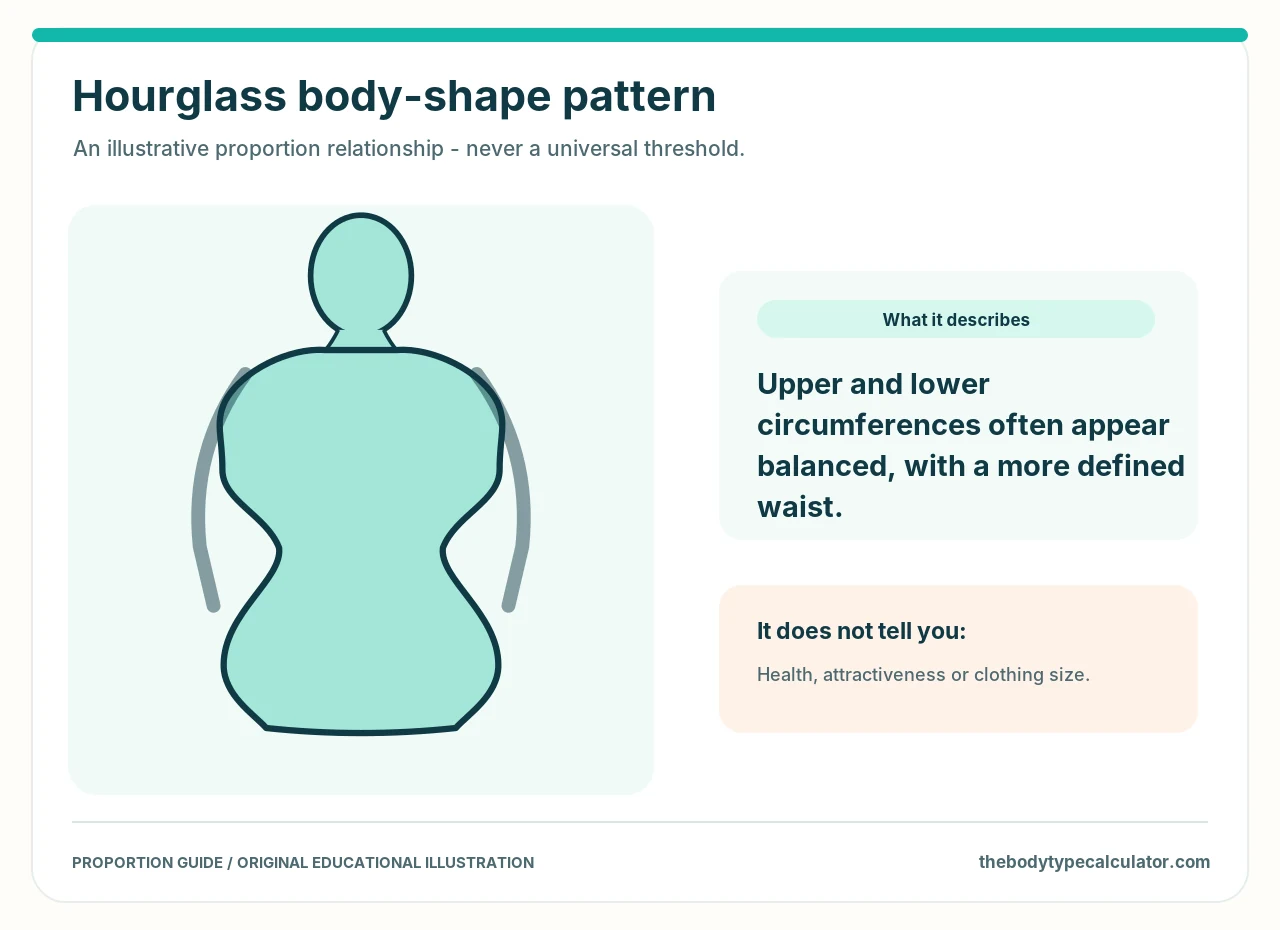
Classic Hourglass vs Top Hourglass vs Bottom Hourglass
Our calculator distinguishes three Hourglass-family results.
Classic Hourglass
A classic Hourglass result is the most balanced version in the calculator.
The calculator requires:
Bust/chest and hips within 1 inch.
Waist at least 9 inches smaller than bust/chest.
Waist at least 9 inches smaller than hips.
The upper and lower measurements are therefore very close while the waist is strongly defined.
Top Hourglass
A Top Hourglass has a defined waist but the bust/chest is somewhat larger than the hips.
In our calculator, Top Hourglass is returned when:
Bust/chest is larger than hips.
The bust–hip difference is no more than 10 inches.
The waist is at least 9 inches smaller than the bust/chest.
Waist-to-hip ratio is below 0.75.
This is a site-specific rule, not a universal definition used by every stylist.
Bottom Hourglass
A Bottom Hourglass has a defined waist but the hips are somewhat larger than the bust/chest.
In our calculator, Bottom Hourglass is returned when:
Hips are larger than bust/chest.
The hip–bust difference is no more than 10 inches.
The waist is at least 9 inches smaller than the hips.
Waist-to-hip ratio is below 0.75.
Again, this describes the rule used by our tool.
What Is a Soft Hourglass Body Shape?
“Soft hourglass” is a common informal search term, but it is not a separate result in our Body Shape Calculator.
People often use it to describe an hourglass-like balance with softer contours, less visually sharp waist definition, or a fuller/softer overall appearance.
There is no standardized soft-hourglass formula used across all body-shape systems.
If your measurements meet our Hourglass, Top Hourglass, or Bottom Hourglass rule, use that calculator result as the site’s formal label. “Soft hourglass” can remain an informal visual description.
What Is a Figure-8 Body Shape?
“Figure 8” is another term used inconsistently across body-shape systems.
Some styling systems use Figure 8 as another name for an hourglass-like silhouette. Others use it for a more specific high-hip or curved-hip pattern.
Because the definition varies, this site does not use Figure 8 as a calculator result.
If you are trying to distinguish an hourglass shape from a high-hip shelf or Spoon pattern, use the optional high-hip measurement in the Body Shape Calculator.
Can You Be Slim and Hourglass?
Yes.
Hourglass describes proportional relationships, not body weight.
A slim hourglass body can have smaller absolute measurements while still showing:
Upper/lower balance.
A noticeably smaller waist.
A similar overall proportion pattern.
The same principle applies to petite and tall bodies.
Can You Be Plus-Size and Hourglass?
Yes.
A plus-size hourglass body can have larger absolute circumferences while preserving the same relationship between upper body, waist, and hips.
Body size and body shape answer different questions.
Size describes absolute garment/body dimensions. Shape describes relative proportions.
Can You Be Athletic and Hourglass?
Yes.
Muscle development does not automatically remove an hourglass proportion pattern.
An athletic person can still have an upper body and hips that remain relatively balanced around a smaller waist.
However, changes in shoulder, chest, waist, glute, or hip measurements can change how a calculator classifies the proportions over time.
Can an Hourglass Body Have Hip Dips?
Yes.
Hip dips describe an indentation or inward curve along the side of the hips. Their visibility depends on factors such as pelvic structure, femur position, muscle, and soft-tissue distribution.
Hip dips do not automatically determine whether someone is or is not Hourglass.
The Body Shape Calculator uses circumferences and proportion rules, not the presence or absence of hip dips.
Can Men Have an Hourglass Body Shape?
A person of any sex can have measurements where the upper torso and hips are relatively balanced around a smaller waist.
However, male-body-type searches often use a different taxonomy.
Our Male Body Type Calculator uses shoulder, waist, and hip circumferences and returns Trapezoid, Rectangle, Oval, Triangle, or Inverted Triangle rather than Hourglass.
If you want that male-specific classification, use the Male Body Type Calculator.
Hourglass Waist-to-Hip Ratio
Waist-to-hip ratio can describe how small the waist is relative to the hips, but WHR alone cannot prove an Hourglass body shape.
Why?
WHR uses only:
Waist circumference.
Hip circumference.
It does not include bust/chest or upper-body balance.
Two people can have the same WHR but very different upper-body proportions.
That is why our Body Shape Calculator uses multiple measurements.
Is 36-24-36 the Ideal Hourglass Figure?
No universal body measurement should be presented as an objectively ideal figure.
36-24-36 is a culturally familiar measurement phrase, but it is only one possible set of proportions and is not required for an Hourglass result.
Our calculator can classify other measurement sets as Hourglass if they meet its rule.
For the history, proportions, and interpretation of that specific measurement phrase, see What Does 36-24-36 Mean?.
Hourglass vs Pear Body Shape
Both Hourglass and Pear shapes can have a noticeably smaller waist.
The main difference is upper-to-lower balance.
Hourglass:
The upper body and hips are relatively balanced.
Pear:
The hips/lower body are more dominant relative to the bust/chest.
Because the distinction can depend on relatively small measurement differences, use the dedicated comparison guide for a deeper breakdown: Pear vs Hourglass Body Shape
Hourglass vs Rectangle Body Shape
Hourglass and Rectangle can both have balanced upper and lower measurements.
The key difference is waist contrast.
Hourglass:
The waist is much smaller relative to bust/chest and hips.
Rectangle:
Bust/chest, waist, and hips are more similar in proportion, so the waist has less contrast.
Hourglass vs Inverted Triangle Body Shape
Hourglass:
Upper body and hips are relatively balanced around a smaller waist.
Inverted Triangle:
The upper torso is more dominant relative to the hips.
Hourglass vs Spoon Body Shape
Hourglass:
Upper and lower proportions are relatively balanced.
Spoon:
The lower body is more dominant and a high-hip shelf is part of the calculator’s pattern.
The high-hip measurement is therefore particularly useful when these shapes seem visually similar.
Is Hourglass the “Best” Body Shape?
No.
Hourglass is one proportion category, not a ranking.
Body-shape labels do not measure:
Health.
Fitness.
Attractiveness.
Femininity.
Masculinity.
Worth.
Clothing quality.
The hourglass silhouette has been emphasized in some fashion traditions and media, but that does not make it an objective standard that other bodies should try to match.
This site uses body-shape categories to describe proportions and help users understand fit—not to grade bodies.
Can Your Body Shape Change?
Yes, a measurement-based result can change when the measurements used by the calculator change.
Changes in:
Waist circumference.
Bust/chest circumference.
Hip circumference.
Muscle development.
Body-fat distribution.
Pregnancy/postpartum changes.
Age-related body changes.
can alter the relationships among the measurements.
If those relationships cross one of the calculator’s boundaries, a later result may be different.
Does an Hourglass Body Mean You Are Healthy?
No.
An Hourglass result is a geometric/proportion label on this site.
It does not diagnose:
Cardiovascular health.
Metabolic health.
Body-fat percentage.
Blood pressure.
Blood glucose.
Cholesterol.
Fitness.
Do not use a fashion/proportion category as a health conclusion.
If you want a specific anthropometric screening ratio, use the Waist-to-Hip Ratio Calculator and read its limitations: Waist-to-Hip Ratio Calculator
How Clothing Fit Can Differ on an Hourglass Shape
Hourglass proportions can create recurring fit differences because a garment that fits the bust or hips may be relatively loose at the waist.
Examples can include:
Trousers or skirts that fit through the hips but gap at the waist.
Shirts that fit the bust but feel loose through the midsection.
Straight-cut dresses that fit the fullest points but do not follow the waist.
Structured jackets that need enough room at the bust while still fitting through the middle.
These are fit observations, not styling rules.
For the dedicated styling page—including dresses, tops, jeans, trousers, skirts, jackets, and outfit ideas—see: How to Dress an Hourglass Body Shape
Frequently Asked Questions
What is an hourglass body?
An hourglass body has relatively balanced upper and lower proportions with a waist that is clearly smaller than both.
What is an hourglass body shape?
It is a proportion-based body-shape label. On this site, the standard Hourglass calculator result requires bust/chest and hips to be within 1 inch and the waist to be at least 9 inches smaller than both.
What are hourglass measurements?
There is no single required measurement set. The important feature is the relationship between the upper body, waist, and hips. Our calculator publishes its exact Hourglass thresholds so you can check them directly.
Do you need 36-24-36 measurements to be hourglass?
No. 36-24-36 is only one possible measurement set. Other measurements can produce the same proportion pattern.
How do I know if I have an hourglass figure?
Measure your bust/chest, natural waist, and hips and use the Body Shape Calculator. The result is more repeatable than judging from a single photo or outfit.
What is a Top Hourglass body shape?
In our calculator, Top Hourglass means the waist is strongly defined while the bust/chest is somewhat larger than the hips.
What is a Bottom Hourglass body shape?
In our calculator, Bottom Hourglass means the waist is strongly defined while the hips are somewhat larger than the bust/chest.
What is a Soft Hourglass body?
Soft Hourglass is an informal descriptive term rather than a standardized calculator result. It usually refers to hourglass-like proportions with a softer overall visual contour.
Can an hourglass body be skinny?
Yes. Body shape is about proportions rather than body weight.
Can an hourglass body be plus-size?
Yes. Larger absolute measurements can still form an hourglass proportion pattern.
Can an hourglass body be athletic?
Yes. Athletic or muscular bodies can still have balanced upper/lower proportions and a smaller waist.
Can an hourglass have hip dips?
Yes. Hip dips do not automatically change the circumference relationships used to classify body shape.
Can men have an hourglass body?
Men can have an upper/lower balance around a smaller waist, but our dedicated male calculator uses a different five-category torso system.
What waist-to-hip ratio is hourglass?
WHR alone does not determine Hourglass because it ignores upper-body measurements. Use bust/chest, waist, and hips together for body-shape classification.
Is hourglass the ideal body shape?
No body shape is objectively ideal. Hourglass is a descriptive proportion pattern, not a beauty or health ranking.
Can an hourglass body shape change?
Yes. If the relationship between bust/chest, waist, and hip measurements changes enough, a measurement-based classification can change.