Guide
What Is a Round Body Shape?
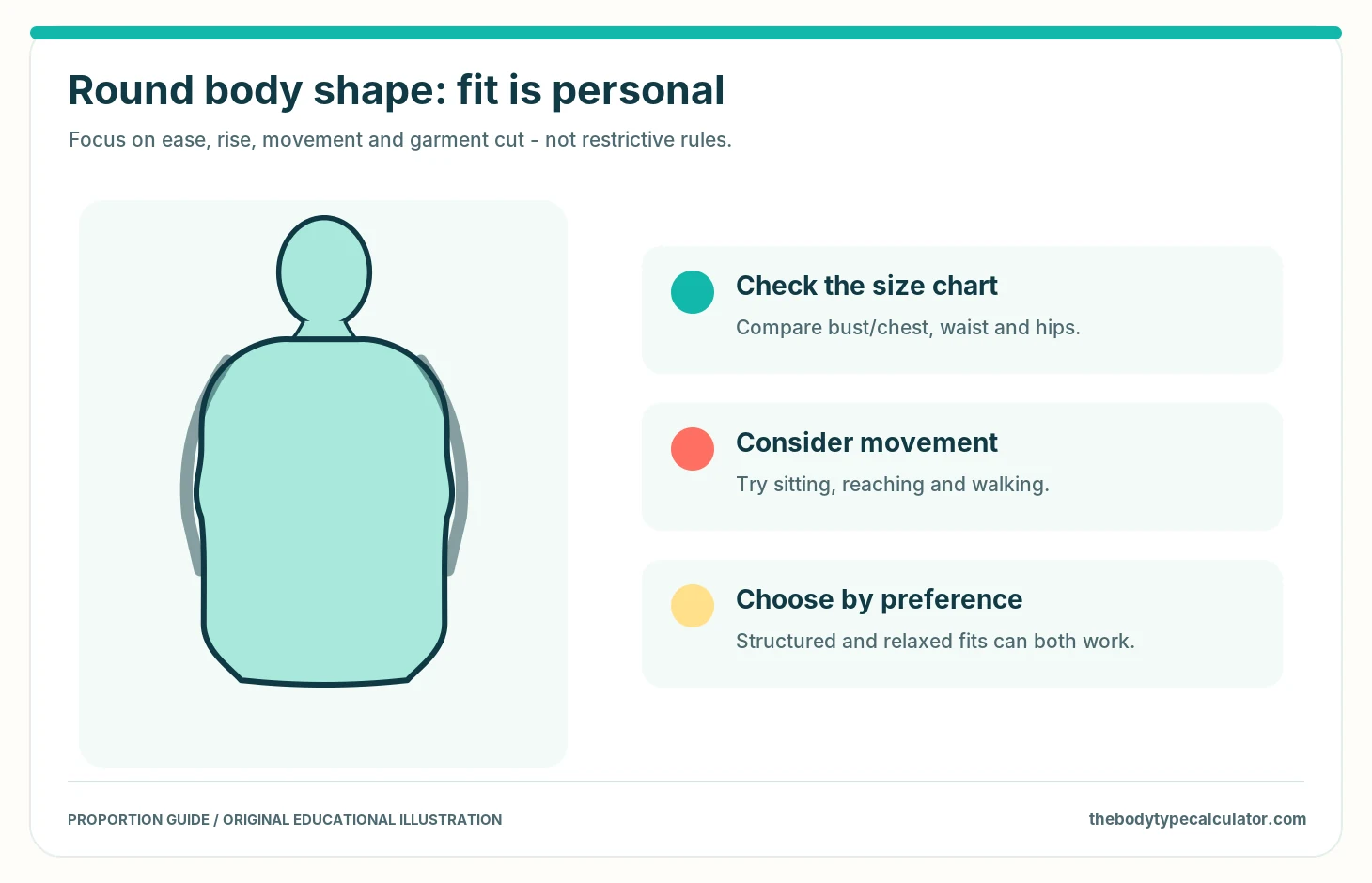
Round body shape is a styling term usually used for proportions with less waist definition and more visual width through the middle of the torso. Many style systems use round, apple and oval for the same general idea rather than treating them as three separate scientific categories.
On this website, the closest measurement-based category is Apple: the waist is relatively close to the bust/chest and hips instead of pulling in much narrower. That relationship matters more than body weight. People at many sizes can have round or apple-like proportions.
The label is only useful if it helps you understand fit or create an outfit you like. It is not a health diagnosis and it does not tell you what parts of your body you should hide.
Round vs Apple vs Oval Body Shape
In everyday styling content, these terms frequently overlap. Round often describes the visual silhouette, Apple is a common women’s body-shape label, and Oval is often used in men’s styling. Different systems set different measurement rules.
Rather than chasing the perfect label, look at the practical pattern: Is your waist close in circumference to your bust/chest and hips? Do fixed waist seams often feel restrictive even when the shoulders or hips fit? Do you prefer garments that skim rather than cinch the middle? Those clues are more useful in a fitting room than the name itself.
How to Dress a Round Body Shape
The most useful approach is to build clean lines and choose where you want visual emphasis. If you want the torso to read longer, use vertical elements. If you want more waist definition, add a seam, wrap or belt at a comfortable point. If you prefer a relaxed silhouette, use structure at the shoulders, hem or trouser line so the outfit still looks intentional.
Tops for a Round Body Shape
- V, scoop, split and open-collar necklines can create vertical space through the upper torso.
- Tops with vertical seams, center plackets or open layers create an up-and-down line.
- Skimming fabrics usually move more cleanly than either very clingy knits or heavy boxy fabric.
- Side slits can reduce bunching at the hip or stomach.
- Choose the hem position deliberately; a top ending at the widest point of the middle creates a strong horizontal break.
- Tucking is optional. Full tuck, front tuck and untucked lengths create different proportions—try them rather than assuming one is forbidden.
Trousers and Jeans
Comfort at the waistband and rise comes first. A trouser that cuts into the middle or slides down will never be improved by the “right” body-shape silhouette.
- Straight-leg trousers create a clean line from hip to hem.
- Bootcut and gentle flare add visual width lower on the leg.
- Wide-leg trousers can balance torso width while giving comfortable movement.
- Flat-front or smoothly finished waistbands reduce extra bulk when that is your preference.
- Elastic, stretch or partially elasticated waist constructions can improve comfort without looking casual when the fabric is structured.
- Choose rise based on torso length and comfort; high rise is not automatically better for every round shape.
Dresses
- Wrap and faux-wrap dresses add diagonal line and adjustable shaping.
- Empire or raised-waist styles move the main horizontal seam above the natural waist.
- A-line and softly flared skirts create movement below the torso.
- Column or shift dresses can create a clean straight silhouette when they have enough room through the middle.
- Princess seams and strategic darts can provide shape without requiring a tight waistband.
- Shirt dresses can be worn open, loose, belted or partially buttoned for different levels of definition.
Jackets and Layers
Open layers are useful because their front edges create strong vertical lines. A single-breasted blazer, cardigan, overshirt or lightweight coat can frame the torso without squeezing it.
- Longline layers emphasize vertical movement.
- Hip-length jackets work best when the hem does not bunch at the widest point.
- Structured shoulders can give the garment a clear frame.
- Softly shaped jackets often sit better than very stiff boxy cuts.
- If you belt a jacket or coat, test the placement rather than assuming the natural waist is the only option.
Skirts
- A-line skirts add width toward the hem and allow room through the middle.
- Straight skirts can create a column if the waistband is comfortable.
- Bias and softly draped skirts move without requiring a hard waist seam.
- Pleats and gathers add volume where they start; place them according to whether you want more or less emphasis at the waist/hip area.
Use Vertical Lines Without Turning Them Into a Rule
Vertical lines can come from open jackets, center-front buttons, long necklaces, tonal dressing, seams or trouser creases. They guide the eye up and down, which can make the overall outfit feel more continuous.
You do not need literal vertical stripes, and you do not need to avoid horizontal stripes. A horizontal detail can be useful when you deliberately want to emphasize shoulders, neckline, hem or legs.
Should a Round Body Shape Wear a Belt?
Yes, if you like the effect. A belt can create a strong focal point and a more defined waist. The key variables are placement, width, contrast and how much the underlying fabric bunches.
Try the same outfit with no belt, a tonal belt and a contrasting belt. If one version creates the silhouette you want and remains comfortable when sitting and moving, that is the right answer for that outfit.
Fabric Choices
Fabric changes how much a garment follows the body. Very thin clingy knits show every contour; heavy stiff fabrics can add bulk because they hold their own shape. Midweight knits, crepe, soft tailoring and drapey woven fabrics often provide a useful middle ground.
This is a construction issue, not a body judgment. The same fabric principle applies to every shape.
Round Body Shape Outfit Formulas
Everyday
Open overshirt or cardigan + simple top + straight jeans + low-profile shoes. The open layer supplies vertical structure while the jeans keep the lower line clean.
Work
Single-breasted blazer worn open + soft blouse + straight or wide-leg trousers. Keep the blouse and trousers close in value if you want an uninterrupted central column.
Dress
Wrap, faux-wrap, A-line or column midi + simple shoe + one focal accessory. Pick the silhouette based on whether you want waist definition or a straighter line.
Traditional or modest dressing
Longline tunic or kurta + straight or gently wide trousers + open layer or dupatta arranged vertically. Pay attention to where the kameez hem lands and whether side slits allow the garment to fall rather than bunch.
What Not to Do: Treat Your Midsection as a Problem
Many older style guides tell round-shaped people to “hide the stomach.” That is not necessary. If you like fitted tops, tucked shirts, belts, bright colors or cropped layers, you can wear them.
The useful information is what each choice does visually. A fitted top reveals the body line; a boxy top creates a straighter outer shape; a belt introduces a waist break; an open jacket adds vertical edges. Choose intentionally rather than dressing from fear.
Round Body Shape vs Clothing Size
Round is a proportion description, not a plus-size synonym. A person can have round proportions at many overall measurements, and a plus-size person can be hourglass, pear, rectangle, inverted triangle or another shape.
How to Identify Your Shape by Measurements
Measure bust/chest, natural waist and full hips. If the waist is relatively close to the upper and lower measurements, the main calculator may return Apple. If you are unsure, use the Body Shape Calculator rather than relying only on a mirror.
Frequently Asked Questions
Is round body shape the same as apple?
Often, yes. Many styling systems use round, apple and oval for closely related proportions. Exact terminology varies, so the measurement relationship is more useful than the label.
Can a slim person have a round body shape?
Yes. Body shape describes relative proportions, not a specific weight or clothing size.
What is the best dress for a round body shape?
There is no single best dress. Wrap, raised-waist, A-line, column and shirt dresses can all work depending on whether you want waist definition, vertical line or a relaxed silhouette.
Are high-waisted trousers best for round bodies?
Not automatically. The best rise depends on torso length, waistband construction and comfort. Try different rises and assess sitting as well as standing.
Can a round body shape wear crop tops?
Yes. A crop top creates a strong horizontal break and changes torso-to-leg proportion. If you like that effect and the fit is comfortable, the body-shape label does not prohibit it.
Does round body shape mean unhealthy?
No. A styling label cannot diagnose health. Health assessment requires appropriate medical context and cannot be inferred from a body-shape name.