
Guide
What Does 36-24-36 Mean?
36-24-36 is a shorthand for three body circumferences in inches: a 36-inch bust, a 24-inch waist and 36-inch hips. The order is bust-waist-hips.
Because the bust and hips are equal while the waist is substantially smaller, those measurements usually describe an hourglass-like proportion. They do not identify a clothing size, height, weight, body-fat percentage or level of health.
The numbers are often discussed as a classic beauty ideal, but they are better understood as one specific set of proportions. There is no universal “ideal” body measurement, and healthy bodies occur across a wide range of sizes and shapes.
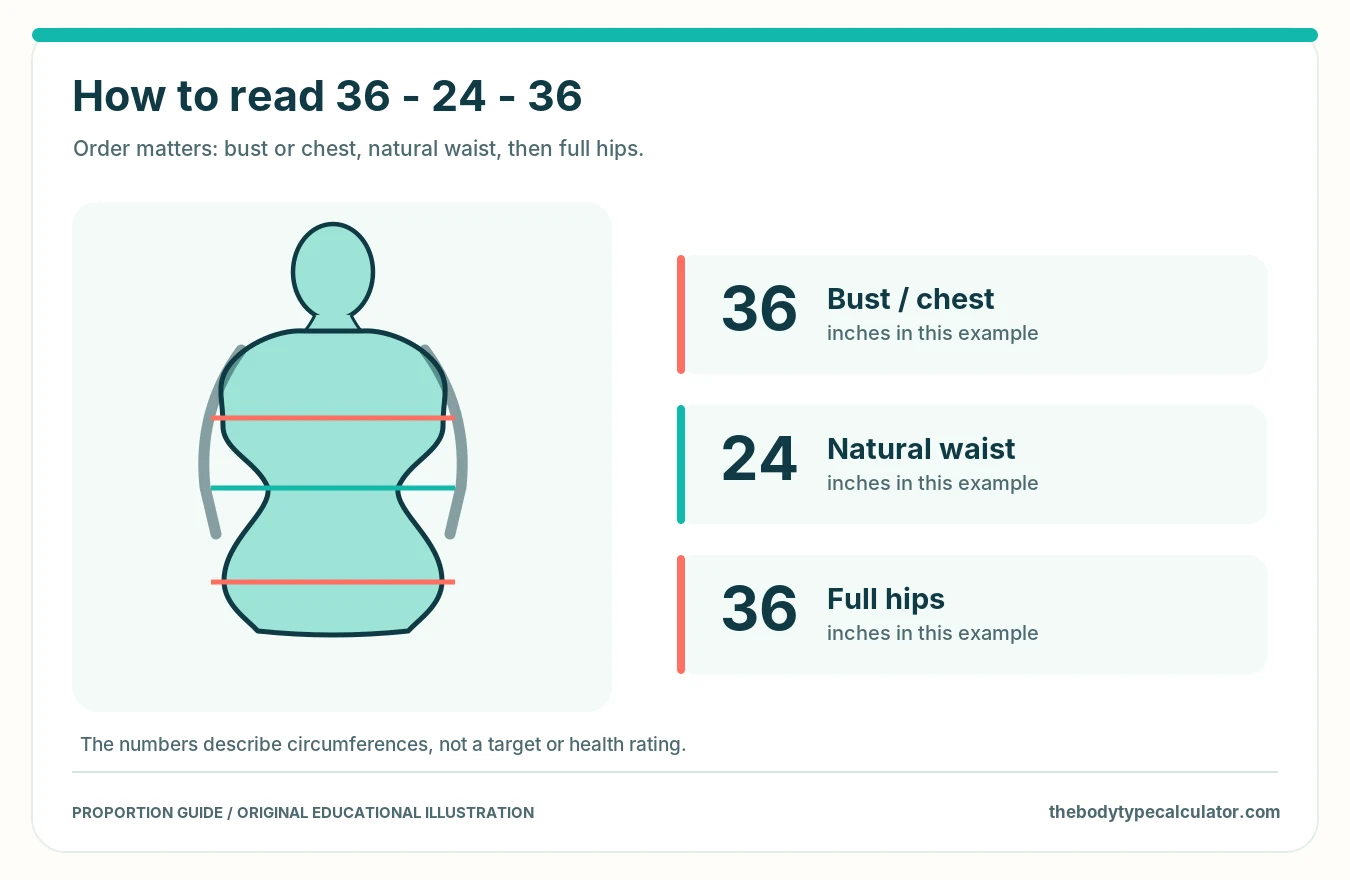
36-24-36 in Bust-Waist-Hip Order
36-inch bust
The first number is the circumference around the fullest part of the bust or chest. It is not the same as a bra band size or underbust measurement.
24-inch waist
The second number is the circumference around the natural waist, usually the narrowest part of the torso between the ribs and hips.
36-inch hips
The third number is the circumference around the fullest part of the hips and seat. It refers to full hip, not high hip.
What Is 36-24-36 in Centimeters?
One inch equals exactly 2.54 centimeters. Converting the three measurements gives approximately 91.4-61.0-91.4 cm.
You may also see 90-60-90 cm used as a similar cultural shorthand. It is close to 36-24-36, but it is not an exact conversion: 90 cm is about 35.4 inches and 60 cm is about 23.6 inches.
What Body Shape Is 36-24-36?
A 36-24-36 set is typically associated with an hourglass body shape because the bust and hips are equal and the waist is markedly smaller.
Using those numbers alone, the waist-to-hip ratio is 24 ÷ 36 = 0.67, and the waist-to-bust ratio is also 0.67. The bust-to-hip ratio is 1.00. Those ratios describe the mathematical relationship between the measurements; they are not beauty scores.
Different body-shape systems use different thresholds, and real bodies do not always fit a single label. If you want a result based on the same rules used across this website, enter your own measurements into the Body Shape Calculator.
Is 36-24-36 a Clothing Size?
No. Clothing sizes are brand-defined labels. A person with 36-24-36 measurements could fall into different sizes for tops, waists and hips within the same brand, and different brands may map the same measurements to different labels.
The unusually large difference between the 24-inch waist and the 36-inch bust/hips can also mean that fitted garments need alteration even when one part of the garment matches well. Use the brand’s actual body-measurement chart rather than trying to convert 36-24-36 into a universal US, UK or EU size.
Is 36-24-36 an “Ideal” Figure?
It has been used as a cultural shorthand for a curvy hourglass figure, especially in Western fashion and popular culture, but that does not make it a biological, medical or universal standard.
Ideas about attractiveness vary across people, cultures, time periods and the way research stimuli are presented. Research on waist-to-hip ratio has found associations with attractiveness judgments in some settings, while later reviews have also criticized overly simple evolutionary explanations and cautioned against turning those findings into universal rules.
Most importantly, a specific set of bust-waist-hip numbers is not a health target. Health cannot be inferred from 36-24-36, and trying to force your body toward exact measurements ignores differences in height, skeleton, genetics and natural fat distribution.
Does Height Change How 36-24-36 Looks?
Yes. Circumference measurements do not include vertical proportions. Two people can both measure 36-24-36 while having different heights, torso lengths, shoulder widths, rib-cage dimensions and leg-to-body proportions. The same three numbers can therefore look quite different on different frames.
Does Weight Determine 36-24-36?
No. Weight is not included in the three-number notation. People with the same bust, waist and hip circumferences can have different body weights because height, bone structure, muscle mass and body composition vary.
Can Someone Be Hourglass Without Measuring 36-24-36?
Absolutely. Hourglass is a proportion label, not an exact measurement requirement. Someone might have measurements such as 32-25-33, 40-31-41 or many other combinations and still have bust and hips that are relatively balanced with a defined waist.
This is why ratios and relative differences are more useful for body-shape classification than copying a famous three-number set.
How to Measure Yourself Correctly
- Bust: measure around the fullest part of the bust/chest with the tape level around your back.
- Waist: measure your natural waist while standing normally and breathing comfortably.
- Hips: measure around the fullest part of the hips and seat, keeping the tape horizontal.
- Use the same unit for all three measurements.
- Measure over thin clothing or underwear rather than bulky layers.
- Repeat a measurement if the tape slipped, twisted or compressed the body.
For a full measuring walkthrough, use the Bust-Waist-Hip Measurements guide or How to Take Body Measurements.
What If My Measurements Are Close to 36-24-36?
Nothing special needs to happen. Treat the numbers as measurements, not a threshold you have to qualify for. A one- or two-inch difference can change the exact ratios, but it does not suddenly make one body “better” or “worse.”
If your purpose is clothing, use your actual measurements against the garment’s size chart. If your purpose is identifying a body shape, use the calculator. If your purpose is health screening, use an appropriate health measurement protocol rather than a fashion proportion.
36-24-36 vs 90-60-90
The two phrases describe similar proportions but are not exact equivalents. 36-24-36 inches converts to about 91.4-61.0-91.4 cm. A literal 90-60-90 cm converts to about 35.4-23.6-35.4 inches.
In casual conversation, both are often used to evoke the same general hourglass idea. In a calculator or size chart, however, use the actual numbers and units rather than treating them as interchangeable.
36-24-36 vs Waist-to-Hip Ratio
Bust-waist-hip notation gives three raw circumferences. Waist-to-hip ratio (WHR) uses only two of them: waist divided by hips.
For 36-24-36, WHR is 24 ÷ 36 = 0.67. WHR is useful for comparing waist and hip proportions, but it cannot tell you whether the bust is balanced with the hips. Two people can have the same WHR and different overall body shapes.
Why Exact Numbers Can Be Misleading
Three circumference measurements leave out shoulder width, torso length, high hip, height and the distribution of volume within the bust and hips. Posture, measuring technique and clothing can also change readings.
That makes 36-24-36 useful as a simple notation example, but too limited to act as a complete description of appearance.
Frequently Asked Questions
What is the order of 36-24-36?
Bust, waist, hips. The first 36 is bust circumference, 24 is natural waist circumference and the final 36 is full hip circumference.
Is 36-24-36 an hourglass figure?
It generally describes hourglass-like proportions because the bust and hips are equal while the waist is much smaller. Exact classifications depend on the rules being used.
What is 36-24-36 in centimeters?
Approximately 91.4-61.0-91.4 cm. The familiar 90-60-90 cm phrase is similar but not an exact conversion.
Is 36-24-36 the perfect body?
No. It is one set of measurements that has been idealized in parts of popular culture. There is no objective, universal set of perfect body measurements.
What dress size is 36-24-36?
There is no single answer because clothing sizes vary by brand and garment. Compare each measurement with the specific brand’s size chart.
Can a taller and shorter person both be 36-24-36?
Yes. The three measurements are circumferences and do not include height, torso length or leg length.
Does 36-24-36 mean healthy?
No. These numbers are not a health assessment. Health depends on many factors that cannot be determined from three fashion measurements.
How do I know my own body shape?
Take your bust/chest, natural waist and full hip measurements, then use the Body Shape Calculator for a consistent measurement-based estimate.