Guide
Hip Measurement Guide: How to Measure Hips + Size Chart
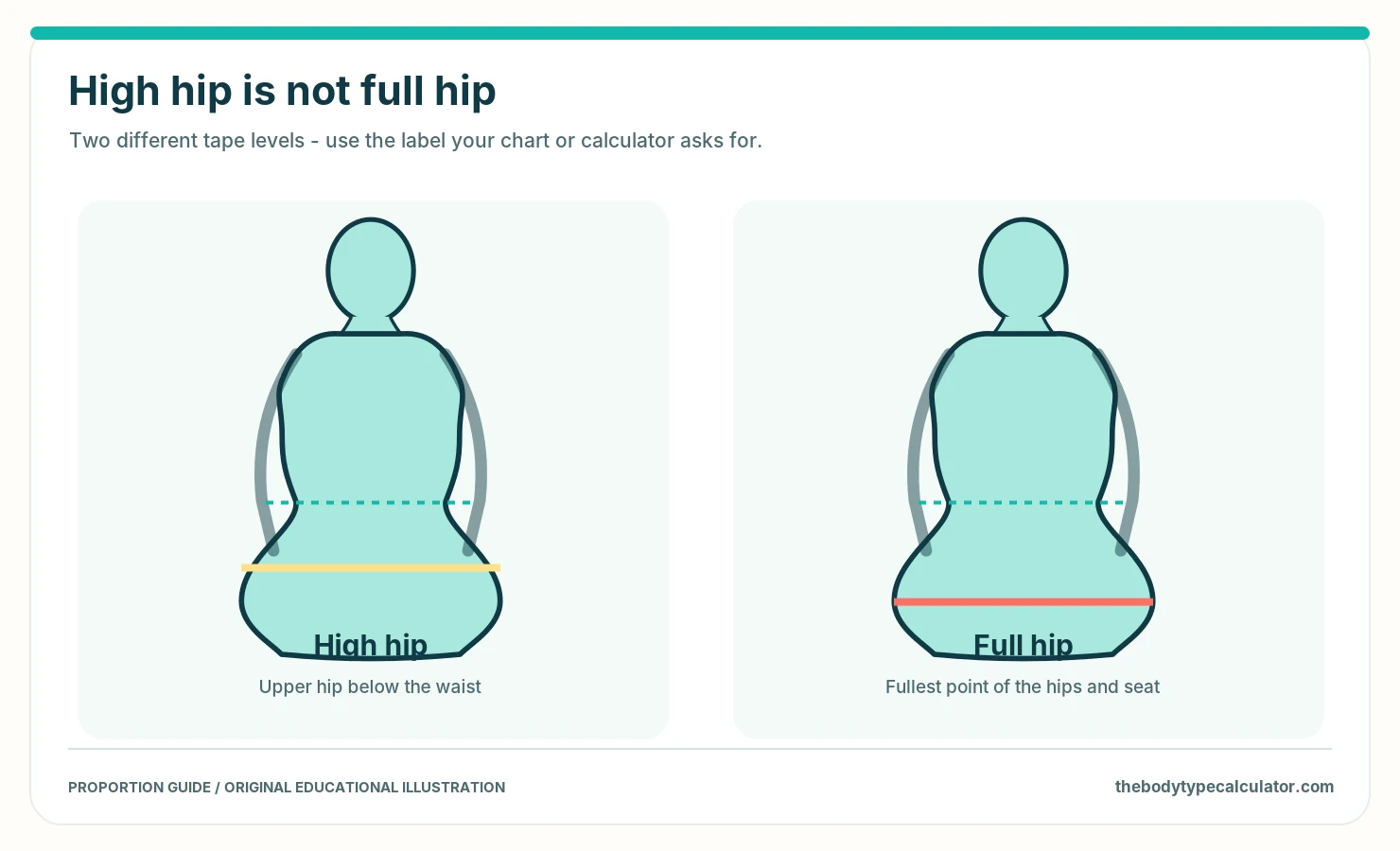
Your hip measurement is the circumference around the fullest part of your hips and seat. For most clothing size charts and body-shape calculators, “hips” means this full-hip measurement — not the upper hip area just below the waist.
Use a soft measuring tape, stand naturally, keep the tape horizontal all the way around, and make it snug without pulling it tight. If the tape slopes across your back or sits above the fullest point of your seat, the number can come out too small.
Where Is Your Hip Measurement Taken?
The full hip is measured around the widest circumference of the hips and buttocks. The exact vertical level varies from person to person, so do not rely on a fixed number of inches below the waist.
Stand in front of a mirror and move the tape slightly up or down until it passes around the fullest point of your seat while remaining level. A side view is especially helpful because the widest point may sit farther back than it appears from the front.
How to Measure Your Hips Step by Step
1. Use a flexible measuring tape
A soft sewing tape follows body curves more accurately than a rigid ruler or metal tape.
2. Wear thin, close-fitting clothing
Measure over underwear or light, fitted clothing when practical. Thick fabric, large pockets and bulky seams can add circumference.
3. Stand naturally
Keep your weight evenly distributed and avoid squeezing your legs together unnaturally or changing your posture to alter the measurement.
4. Find the fullest point
Wrap the tape around your hips and seat, then use a mirror or side view to locate the maximum circumference. The fullest point may not align with the top of your hip bones.
5. Keep the tape level
Check that the tape is parallel to the floor all the way around. A tape that rises at the back or drops at the front can produce a misleading number.
6. Keep it snug, not tight
The tape should stay in contact with the body without compressing soft tissue. You should not be able to pull it far away from your body, but it should not dig in.
7. Repeat the measurement
Take the measurement again from a relaxed position. If the two readings differ, reset the tape and check placement rather than simply choosing the smaller number.
High Hip vs Full Hip
High hip and full hip are different measurements. High hip is taken around the upper pelvic area below the natural waist. Full hip is taken around the widest part of the hips and seat.
Sewing patterns and tailoring systems sometimes ask for both because the difference between upper hip and full hip affects how a fitted skirt or pair of trousers moves from the waist over the pelvis and seat.
On this website, a field labeled “hips” means full hip unless it explicitly says “high hip.” The main Body Shape Calculator uses full hip as a required measurement and high hip as an optional measurement.
Hip Measurement in Inches and Centimeters
One inch equals exactly 2.54 centimeters. Multiply inches by 2.54 to convert to centimeters, or divide centimeters by 2.54 to convert to inches.
Quick conversion examples:
- 34 in = 86.4 cm
- 36 in = 91.4 cm
- 38 in = 96.5 cm
- 40 in = 101.6 cm
- 42 in = 106.7 cm
- 44 in = 111.8 cm
- 46 in = 116.8 cm
- 48 in = 121.9 cm
- 50 in = 127.0 cm
Hip Measurement Chart: Inches and Centimeters
There is no universal US hip-size chart. Brands use different fit models, ease allowances and size labels. Use the size chart for the exact garment you are buying.
The table below converts hip circumference from inches to centimeters; it does not assign clothing sizes. One inch equals exactly 2.54 centimeters. Values are rounded to one decimal place.
| Inches | Centimeters |
|---|---|
| 34 | 86.4 |
| 35 | 88.9 |
| 36 | 91.4 |
| 37 | 94.0 |
| 38 | 96.5 |
| 39 | 99.1 |
| 40 | 101.6 |
| 41 | 104.1 |
| 42 | 106.7 |
| 43 | 109.2 |
| 44 | 111.8 |
| 45 | 114.3 |
| 46 | 116.8 |
| 47 | 119.4 |
| 48 | 121.9 |
| 49 | 124.5 |
| 50 | 127.0 |
| 51 | 129.5 |
| 52 | 132.1 |
Why Hip Measurement Alone Cannot Tell You Your Clothing Size
A dress, skirt or pair of trousers has to fit more than one part of the body. Your hip measurement might align with one size while your waist or bust aligns with another.
Fabric stretch, rise, cut, intended ease and garment style also matter. A rigid woven trouser may need more attention to hip fit than a stretch legging, while a loose dress may be selected primarily from the bust measurement.
When measurements span multiple sizes, choose according to the garment’s most restrictive area and the brand’s fit guidance. Tailoring can sometimes solve the difference more effectively than forcing all measurements into a single size label.
Body Hip Measurement vs Garment Hip Measurement
A body hip measurement is taken around your body. A garment hip measurement is measured on the finished clothing item and usually includes ease so you can move and sit comfortably.
Do not compare a finished-garment circumference directly with your body circumference unless the brand specifically explains how much ease is intended. A garment can measure several inches larger than the body it is designed to fit.
How to Measure Hips for Jeans and Trousers
Start with your full hip body measurement, then compare it with the brand’s body-size chart. For trousers, also check waist, rise and inseam. If the product page publishes finished garment measurements instead, follow that brand’s instructions rather than assuming they are body measurements.
If you have a pair of trousers that fits well, measuring the garment can be a useful comparison, but remember that flat garment width is typically half the circumference. A 20-inch flat hip width corresponds to roughly 40 inches around before accounting for construction, stretch and where the garment was measured.
How to Measure Hips for a Body Shape Calculator
Use the same full-hip measurement described above. The calculator compares the hips with bust/chest and waist measurements, so entering high hip instead of full hip can make the lower body appear smaller in the calculation than it actually is.
If the calculator also offers a separate high-hip field, measure that independently rather than reusing your full-hip number. Record the two readings separately on the printable body measurement chart so you can check which one each input needs.
Common Hip-Measurement Mistakes
- Measuring around the hip bones instead of the fullest circumference of hips and seat.
- Letting the tape rise at the back.
- Measuring the high hip when the chart asks for full hip.
- Pulling the tape tight enough to compress the body.
- Measuring over thick jeans, heavy fabric or bulky pockets.
- Reading the tape while twisting your torso.
- Assuming a hip number maps to one universal clothing size.
- Confusing a flat garment width with a body circumference.
What Is an Average Hip Size?
An “average” hip circumference is not very useful for choosing clothing or identifying body shape because population averages vary by age, height, sex, country and dataset. For fit, your own measurement and the garment’s chart matter far more than an average.
This page therefore avoids presenting a single average as a target. If you are researching anthropometric population data for design or ergonomics, use the specific dataset and population relevant to your project.
Does Hip Measurement Tell You Your Body Shape?
Not by itself. Body shape depends on how the hips compare with the waist and upper body. A 40-inch hip measurement can be relatively broad on one frame and relatively balanced on another.
Use bust/chest, waist and full hip together for a basic body-shape estimate. The Body Shape Calculator can compare those measurements consistently.
Frequently Asked Questions
Where exactly do I measure my hips?
Around the fullest circumference of your hips and buttocks. Keep the tape level and check the placement from the side or back if possible.
How far below the waist are hips measured?
There is no fixed distance that works for everyone. Find the fullest point of your hips and seat rather than measuring a predetermined number of inches below the waist.
Are hips and high hips the same?
No. High hip is the upper pelvic area below the waist; full hip is the widest circumference of the hips and seat.
Should I measure hips with my feet together?
Many apparel guides use a neutral stance with the feet together or close together. The most important point is to stand naturally and repeat the same stance when comparing measurements over time.
What size is a 40-inch hip?
There is no universal answer. In current US retailer charts, a 40-inch hip often appears around the numeric 10 range, but brands vary. Use the exact brand chart before purchasing.
What size is a 44-inch hip?
A 44-inch hip may appear around US 14 in some current charts and a different size in others. Treat generic conversion charts as rough orientation only.
Can I measure hips over jeans?
For the most repeatable body measurement, use underwear or thin, close-fitting clothing. Thick denim, pockets and seams can add to the circumference.
Why is my hip measurement different from a size chart?
The chart may use body measurements, garment measurements or a different fit block. Check the chart heading and measurement instructions before comparing numbers.