Guide
Rectangle Body Shape: Measurements, Characteristics & Style Guide
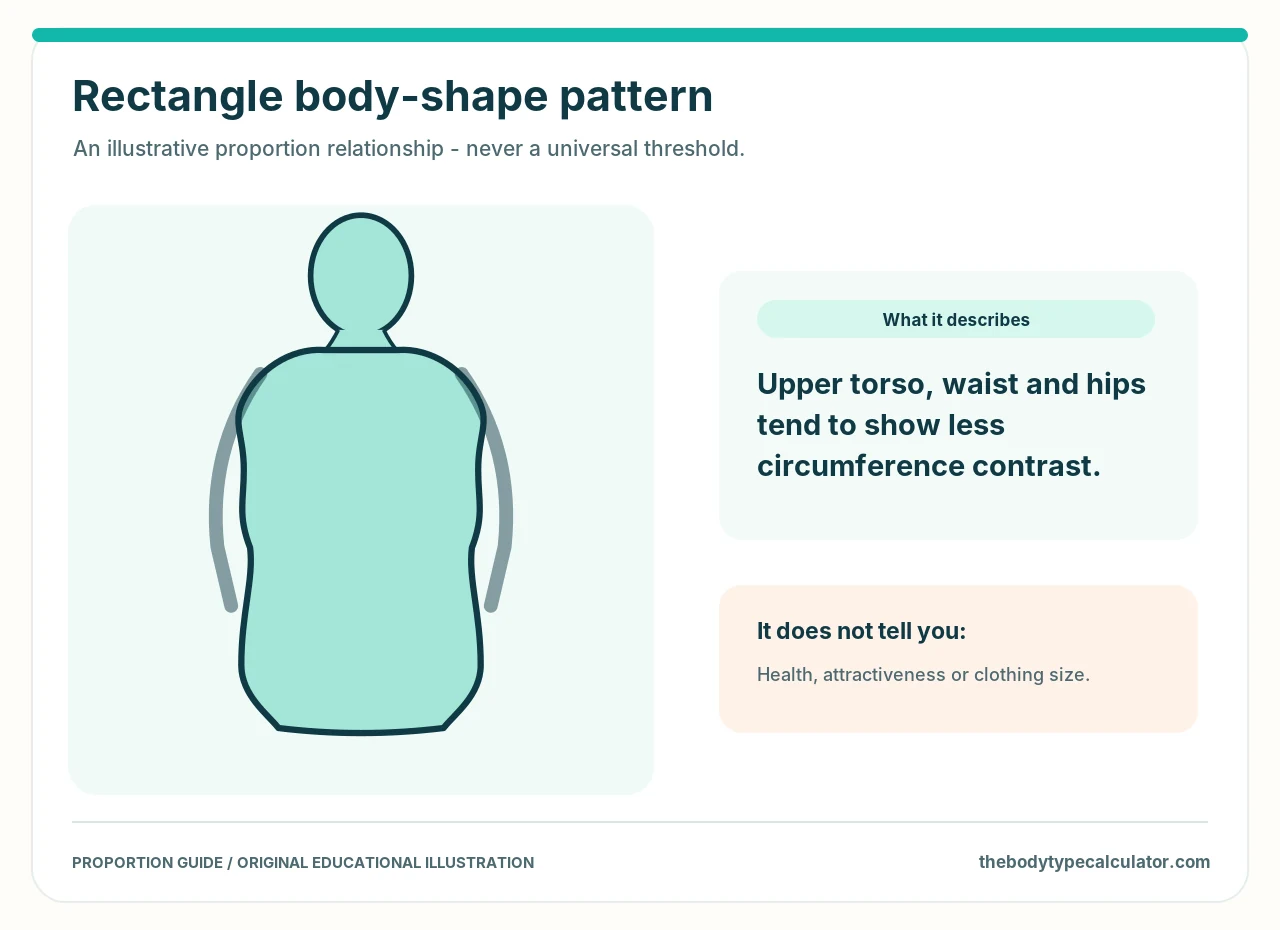
A Rectangle body shape describes a proportion pattern where the bust/chest and hips are relatively balanced and the waist has less contrast than in an Hourglass or Pear shape.
The silhouette can look straighter through the torso, but “Rectangle” does not mean your body is literally box-shaped or that you have no curves. It simply describes how the main circumferences relate to one another.
You can be slim, curvy, athletic, petite, tall, midsize, plus-size, or have a visible tummy and still have Rectangle proportions.
If you want to check your measurements, use the Body Shape Calculator.
What Is a Rectangle Body Shape?
A Rectangle body shape has relatively even proportions through the bust/chest, waist, and hips, with less waist definition than an Hourglass.
Common characteristics include:
Bust/chest and hip measurements that are fairly close.
A waist that is only moderately smaller than the bust/chest and hips.
A straighter-looking transition from upper torso to waist to hips.
No single region strongly dominating the silhouette.
A balanced or column-like overall proportion.
Rectangle is also called Straight, Banana, Ruler, Column, H-shape, or sometimes Athletic in different style systems.
Those names are not standardized. “Athletic” especially can be misleading because muscle mass and fitness are not measured by this classification.
On this site, Rectangle is the neutral name for this proportion pattern.
Rectangle Body Shape Characteristics
A Rectangle-shaped body may have:
Bust/chest and hips that are similar in circumference.
Moderate or low waist contrast.
A fairly straight torso outline.
Shoulders that appear visually balanced with the hips.
Clothing that fits similarly through the bust and hips but may feel less shaped at the waist.
A Rectangle body can also have:
A visible tummy.
Curvier hips.
A fuller or smaller bust.
Broad or narrow shoulders.
Hip dips.
Muscular legs or shoulders.
A petite, tall, slim, midsize, or plus-size frame.
The label does not require every feature in a stereotype.
Rectangle Body Shape Measurements
There is no single universal Rectangle formula used by every fashion guide or calculator.
Our Body Shape Calculator uses two possible Rectangle rules, after the earlier shape rules have been checked.
Rectangle Rule 1
Rectangle is returned when:
Bust/chest and hips are within 2 inches of each other.
AND
The waist is within 2 inches of the bust/chest.
AND
The waist is within 2 inches of the hips.
In formula form:
|bust − hips| ≤ 2 inches
AND
|waist − bust| ≤ 2 inches
AND
|waist − hips| ≤ 2 inches
This covers very even measurement sets.
Rectangle Rule 2
Rectangle is also returned when:
Waist-to-hip ratio is at least 0.78.
AND
Waist-to-bust ratio is at least 0.78.
AND
Bust/chest and hips are within 3 inches of each other.
In formula form:
waist ÷ hips ≥ 0.78
AND
waist ÷ bust/chest ≥ 0.78
AND
|bust − hips| ≤ 3 inches
This second rule allows a moderate amount of waist definition while keeping the upper and lower body relatively balanced.
These are the rules used by our calculator—not universal fashion or medical definitions.
Rectangle Rule Order Matters
Plugin v2 checks the following categories before Rectangle:
Hourglass
Top Hourglass
Bottom Hourglass
Spoon
Triangle
Pear
Inverted Triangle
Apple
Rectangle is considered only after those earlier rules do not match.
This is especially important when comparing Rectangle with Apple.
Apple is checked first. If the waist is sufficiently close to the bust/chest or hips to meet the Apple rule, the calculator returns Apple before it reaches Rectangle.
If neither Rectangle rule matches, the v2 calculator keeps the default result Balanced / Mixed rather than forcing every remaining measurement set into Rectangle.
Rectangle Body Shape Examples
Example 1:
Bust/chest: 36 in
Waist: 31 in
Hips: 37 in
Bust–hip difference:
1 inch
Waist-to-bust:
31 ÷ 36 ≈ 0.861
Waist-to-hip:
31 ÷ 37 ≈ 0.838
The first Rectangle rule does not apply because the waist is more than 2 inches away from the bust and hips.
The second rule does apply:
Both waist ratios are above 0.78 and bust/chest and hips are within 3 inches.
Provided no earlier Apple or other shape rule triggers, this pattern returns Rectangle.
Example 2:
Bust/chest: 36 in
Waist: 35 in
Hips: 36 in
These measurements are extremely close, but the Apple rule is checked before Rectangle.
Because the waist is at least 95% of both bust/chest and hips, this combination returns Apple rather than Rectangle.
That is why rule order matters more than a generic statement such as “similar measurements = Rectangle.”
How to Measure for a Rectangle Body Shape
Use a flexible, non-stretch tape and stand naturally.
Bust or chest
Measure around the fullest part of the bust/chest. Keep the tape horizontal and snug without compressing the body.
Waist
Measure around your natural waist, usually the narrowest part of the torso. Do not pull your stomach in or tighten the tape.
Hips
Measure around the fullest part of the hips and seat.
High hip
High hip is optional in the general calculator. It helps identify Spoon but is not required for Rectangle.
For the full measurement process, see How to Take Body Measurements Correctly.
How Do I Know If I Have a Rectangle Body Shape?
The most repeatable method is to measure.
1. Measure bust/chest.
2. Measure natural waist.
3. Measure hips.
4. Enter the measurements into the Body Shape Calculator.
5. Compare Rectangle with Apple and Hourglass if your measurements sit near a boundary.
6. Use the visual Body Shape Test if you do not have measurements.
What Does a Rectangle Body Shape Look Like?
A Rectangle body shape usually reads as relatively balanced from the upper torso to the hips, with less inward narrowing at the waist than an Hourglass.
The line can look:
Straight.
Column-like.
Moderately curved rather than strongly cinched.
Balanced above and below the waist.
A person does not need to look thin or athletic to be Rectangle.
A fuller Rectangle may still have a straighter proportional pattern, while a slim Rectangle may have the same measurement relationships at a smaller absolute size.
Rectangle Body Shape Illustration
Rectangle vs Apple Body Shape
Rectangle and Apple are commonly confused because both can have less waist definition than Hourglass.
In plugin v2, Apple is checked before Rectangle.
Apple is returned when:
waist ≥ 95% of bust/chest
OR
waist ≥ 95% of hips
OR
waist-to-bust and waist-to-hip are both at least 0.85.
Rectangle requires the Apple rule not to trigger first.
A useful way to think about the difference:
Apple = the waist is very close to the bust/chest or hips.
Rectangle = the measurements are relatively balanced, but the waist still has enough separation to avoid the Apple rule.
Rectangle vs Hourglass Body Shape
Rectangle and Hourglass can both have bust/chest and hips that are close in measurement.
The key difference is waist definition.
Hourglass in our calculator requires:
Bust/chest and hips within 1 inch.
Waist at least 9 inches smaller than bust/chest.
Waist at least 9 inches smaller than hips.
Rectangle has much less waist contrast.
In simple terms:
Hourglass = balanced upper/lower body + strongly defined waist.
Rectangle = balanced upper/lower body + moderate or low waist definition.
Rectangle vs Pear Body Shape
Rectangle:
Bust/chest and hips stay relatively close.
Pear:
Hips are larger than the bust/chest and the waist remains comparatively defined.
Rectangle vs Inverted Triangle Body Shape
Rectangle:
Upper and lower measurements remain relatively balanced.
Inverted Triangle:
Bust/chest is substantially larger than hips with a comparatively smaller waist.
Rectangle vs Spoon Body Shape
Rectangle and Spoon can occasionally be confused visually when the lower body is only moderately fuller.
Spoon in plugin v2 depends on a specific high-hip pattern:
Hips at least 2 inches larger than bust/chest.
High hip entered.
High hip at least 2 inches larger than waist.
Waist ÷ high hip at least 0.84.
Rectangle does not require a high-hip shelf.
What Is a Soft Rectangle Body Shape?
“Soft Rectangle” is an informal descriptive term rather than a separate result in our calculator.
People may use it for a Rectangle-like proportion pattern with softer curves, a fuller bust or hips, more body softness, or a less angular visual line.
There is no standardized Soft Rectangle formula.
If the measurements satisfy the Rectangle rule in our calculator, the formal site result remains Rectangle.
Can a Rectangle Body Shape Be Curvy?
Yes.
“Rectangle” does not mean “no curves.”
A person can have fuller hips, breasts, thighs, or glutes and still have a relatively balanced bust-waist-hip relationship.
The question is not whether curves exist. The question is how much the waist contrasts with the bust/chest and hips.
Can a Rectangle Body Shape Have a Tummy?
Yes.
A visible tummy does not automatically make someone Apple.
The calculator does not visually inspect the abdomen. It uses circumference relationships.
If the waist becomes close enough to bust/chest or hips to meet the Apple rule, the result can be Apple. Otherwise, a person can still meet the Rectangle rule while having visible abdominal fullness.
Can a Rectangle Body Shape Be Skinny or Slim?
Yes.
Rectangle is based on proportions, not weight.
A slim Rectangle can have smaller measurements overall while bust/chest, waist, and hips remain relatively balanced.
Can a Rectangle Body Shape Be Plus-Size?
Yes.
A plus-size Rectangle can have larger absolute measurements while preserving the same proportion pattern.
Body size and body shape answer different questions.
Can a Rectangle Body Shape Be Athletic?
Yes, but “athletic” and “Rectangle” are not the same thing.
Some fashion guides use “athletic” as a synonym for Rectangle because a straight torso can occur in muscular builds.
But athletic ability, muscle mass, strength, and fitness are not measured by the body-shape calculator.
Can a Rectangle Body Shape Have Hip Dips?
Yes.
Hip dips can appear across many body shapes.
They are not part of the Rectangle calculation.
The tool uses circumference measurements rather than the presence or absence of an indentation at the side of the hips.
Rectangle Body Shape for Women
“Rectangle body shape women” and “rectangle body shape female” are common searches because this taxonomy is often presented in women’s fashion.
The basic proportion description is:
Bust/chest and hips relatively balanced.
Moderate or low waist contrast.
These proportion labels are not biologically exclusive to women.
Rectangle Body Shape for Men
Men can also have relatively balanced shoulder/waist/hip proportions.
However, the site has a separate Male Body Type Calculator.
Its Rectangle result is based on shoulder circumference, waist circumference, and hip circumference—not the general bust/chest-waist-hip rules on this page.
For male-specific classification, use the Male Body Type Calculator.
How to Dress a Rectangle Body Shape
There is no requirement to dress a Rectangle body to look more Hourglass.
You can choose either of two styling directions:
Emphasize the natural straight, balanced silhouette.
OR
Use clothing structure, volume, color, or waist details to create more visual contrast.
The better option depends on the look you want.
Best Tops for a Rectangle Body Shape
Useful options can include:
Wrap tops if you want more visible waist shaping.
Peplum tops if you want volume above or below the waist.
Cropped tops with higher-rise bottoms if you want to visually break the torso.
Structured shirts and blazers if you want to emphasize the straight line.
Statement sleeves or shoulder detail if you want more upper-body volume.
Fitted knits if you prefer a clean column silhouette.
Avoid treating any neckline or top style as universally forbidden. Personal preference, bust size, shoulder line, and garment cut all matter.
Best Dresses for a Rectangle Body Shape
Popular options include:
Wrap dresses.
Fit-and-flare dresses.
Belted dresses.
Shirt dresses with adjustable waist shaping.
Ruched dresses.
Peplum dresses.
A-line dresses.
Shift or column dresses when you want to emphasize the straight silhouette.
There is no single “best dress.”
Some cuts create more waist contrast; others deliberately preserve the Rectangle line.
Best Jeans and Pants for a Rectangle Body Shape
Depending on the effect you want:
High-rise jeans can create a stronger waist break.
Wide-leg trousers can add volume below the waist.
Bootcut or flare jeans can change the lower-body balance.
Straight-leg jeans can emphasize the natural column silhouette.
Pleated or cargo trousers can add lower-body structure.
Fitted trousers can preserve a streamlined line.
Fit at the waist and hips matters more than the label alone.
Rectangle Body Shape With a Tummy: Clothing Fit
If you have Rectangle proportions plus more visible abdominal fullness, prioritize garment comfort and fit rather than trying to “hide” the area.
Useful practical features can include:
Comfortable waistbands.
Mid- or high-rise trousers that sit smoothly where you prefer.
Wrap or ruched construction if you like adjustable shaping.
Open jackets or vertical layers if you prefer a longer visual line.
Fabrics with enough structure to avoid unwanted pulling.
These are styling options, not rules.
Swimwear for a Rectangle Body Shape
Common styling approaches include:
Color-blocked swimwear.
Belts or waist details.
Cut-outs if you want to create visual waist contrast.
Ruffles or volume at the bust/hip area.
High-cut legs to change the visual proportions.
Simple athletic one-pieces if you prefer to emphasize a straight silhouette.
Choose support and comfort first.
Rectangle Body Shape Outfit Ideas
Instead of one formula, use proportion-building combinations.
Examples:
Fitted top + wide-leg trousers.
Cropped jacket + high-rise jeans.
Belted shirt dress.
Simple tank + pleated trousers.
Fitted knit + A-line skirt.
Straight blazer + straight-leg trousers for a column look.
Statement-sleeve top + clean jeans.
Wrap top + tailored pants.
The point is to decide whether you want to emphasize balance or create more contrast.
Is Rectangle the Same as a Banana, Ruler, or Straight Body Shape?
Often, yes in everyday fashion language.
Different sites use Rectangle, Straight, Banana, Ruler, Column, H-shape, and similar labels for broadly related low-waist-contrast proportions.
There is no universal naming authority.
This site uses Rectangle for consistency.
Is Rectangle the Most Common Body Shape?
Some online sources and sizing studies are frequently cited to support that claim, but prevalence estimates depend heavily on:
The population studied.
The classification rules used.
Age.
Geography.
Measurement technique.
How borderline cases were assigned.
For that reason, this site does not present Rectangle as universally the most common body type.
Can You Identify Body Shape from Photos?
Body-shape labels for celebrities and models are usually visual estimates from photographs rather than verified circumference measurements. A photograph alone cannot confirm a Rectangle result under this calculator’s rules.
Is Rectangle Body Shape Attractive?
Attractiveness is subjective.
Rectangle is a proportion category, not a beauty score.
The calculator does not rank body shapes as better or worse.
Can a Rectangle Body Shape Change?
Yes.
If bust/chest, waist, or hip measurements change enough, a later calculator result can change.
Changes in body composition, muscle development, pregnancy/postpartum measurements, aging, or other factors can alter the relationships among measurements.
If those proportions cross a threshold, the result may move toward Apple, Hourglass, Pear, Inverted Triangle, or another category.
Frequently Asked Questions
What is a Rectangle body shape?
A Rectangle body shape has relatively balanced bust/chest and hip measurements with less waist definition than an Hourglass.
What are Rectangle body shape measurements?
There is no universal measurement set. Our calculator uses two published Rectangle rules based on measurement differences and waist-to-bust/waist-to-hip ratios.
How do I know if I have a Rectangle body shape?
Measure your bust/chest, waist, and hips and use the Body Shape Calculator. If your result is near Apple or Hourglass, compare the exact rules.
Can a Rectangle body shape have a tummy?
Yes. A visible tummy does not automatically determine the category. The calculator uses circumference relationships.
Can a Rectangle body shape be curvy?
Yes. Curves can exist while the overall bust-waist-hip relationship remains Rectangle.
Can a Rectangle body shape be plus-size?
Yes. Body shape is based on proportions rather than clothing size or weight.
Can a Rectangle body shape be athletic?
Yes. Athletic builds can have Rectangle proportions, but Rectangle does not measure fitness or muscle mass.
Can a Rectangle body shape have hip dips?
Yes. Hip dips are not part of the calculator’s classification logic.
What is the difference between Rectangle and Apple?
Apple is checked first and has stricter waist-proximity thresholds. Rectangle describes relatively even measurements after the Apple rule and earlier shape rules do not match.
What is the difference between Rectangle and Hourglass?
Both can have balanced bust/chest and hips. Hourglass has much stronger waist definition.
What is a Soft Rectangle body shape?
Soft Rectangle is an informal visual term, not a separate calculator result. It usually refers to Rectangle-like proportions with softer curves or body contours.
Is Rectangle the same as Banana body shape?
Often, yes in everyday fashion terminology. The names are not standardized.
What clothes suit a Rectangle body shape?
That depends on your goal. Wrap, belted, peplum, fit-and-flare, wide-leg, and structured pieces can create more contrast; straight and column silhouettes can emphasize the natural balanced line.
Can men have a Rectangle body shape?
Yes, but the site’s Male Body Type Calculator uses a separate shoulder/waist/hip Rectangle rule.
Is Rectangle body shape attractive?
Attractiveness is subjective. Rectangle is not a beauty ranking.